The Discount Approval Confidence Check: Is This Pricing Exception Safe Enough to Trust?
- Jason B. Hart
- Revenue Operations
- May 13, 2026
- Updated May 17, 2026
Table of Contents
What is the discount approval confidence check?
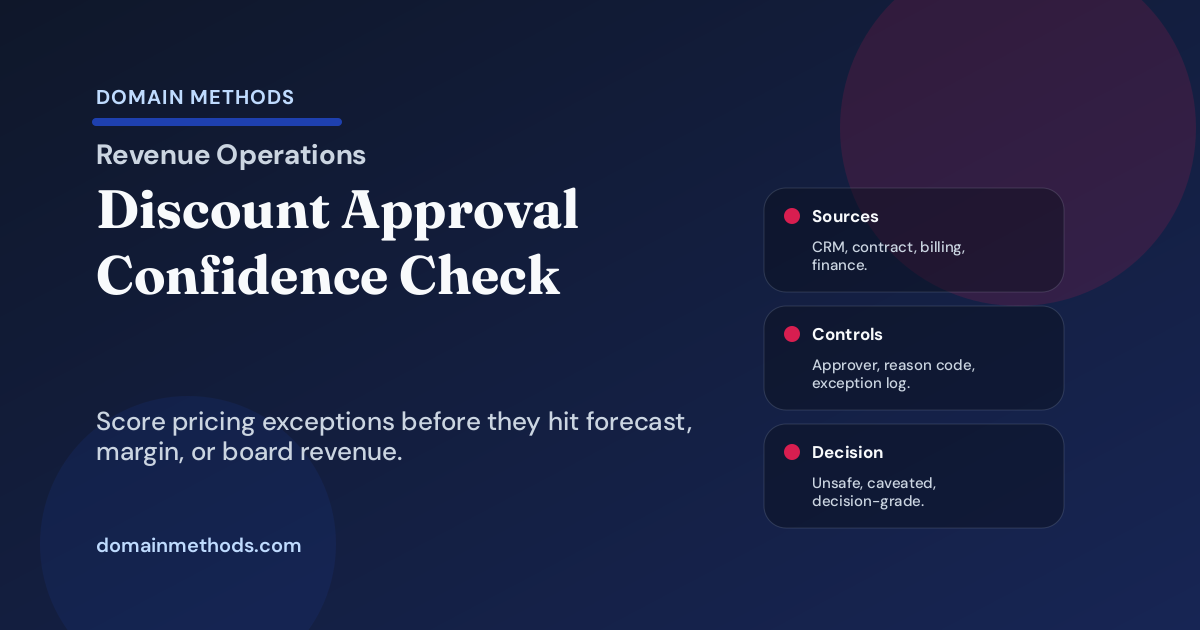
The Discount Approval Confidence Check is a practical way to decide whether a discount, pricing exception, or contract concession is trustworthy enough for the revenue decision attached to it.
Discounting usually starts as a sales-process exception. A strategic account needs a special rate. A renewal gets a temporary concession. A partner deal has different economics. A multi-year contract trades price for commitment. The approval feels reasonable in the moment.
Then the numbers move downstream.
Sales sees an approved discount in the CRM. Finance sees a different treatment in the contract or billing system. RevOps sees a reason code that says “competitive” when the real issue was implementation risk. Marketing or growth wants to understand whether spend is creating profitable demand, but the revenue story has already been softened by exceptions nobody can separate cleanly.
The problem is not whether discounting is good or bad. The problem is whether the company knows which discount rules are stable enough to use for forecast, renewal, compensation, margin, and board-facing ARR commentary.
A discount can be directionally useful before it is finance-aligned. It should not quietly become the number everyone trusts just because it appeared in a dashboard.
Why pricing exceptions get expensive fast
Discount confidence sits where sales urgency, finance policy, RevOps workflow, and data quality collide.
Each team has a reasonable concern:
- Sales wants enough flexibility to win or retain strategic accounts.
- Finance wants revenue, margin, and recognition rules to match the contract, not the latest CRM field.
- RevOps wants approval paths, reason codes, and exception logs that survive quarter-end review.
- Growth wants to know whether campaigns are creating deals the business actually wants.
- Data and analytics want source precedence before a pricing exception becomes a metric input.
The operator-level detail that often exposes the weakness is not the headline discount. It is the treatment of terms around it: ramped pricing, free months, bundled implementation, renewal caps, partner margins, multi-year concessions, or one-time credits that never fit neatly in a single percentage field.
This is also where deal desk reporting can mislead leadership. The deal desk may be doing its job by helping sales move a complex exception through approval. The analytics problem starts later, when the approved exception is reused as evidence of price realization, ARR leakage, renewal risk, or margin pressure without a clean link back to signed terms and billing treatment.
That is how a clean-looking “20% discount” can mean five different things depending on whether sales, billing, finance, RevOps, or the warehouse is asked.
Start with the decision, not the discount percentage
Do not start by asking whether the discount field is accurate. Start by naming the decision leaders want the rule to support.
| Decision | What leaders usually need | Minimum confidence bar |
|---|---|---|
| Weekly pipeline or deal review | A rough read on pricing pressure and exception volume | Usable with caveats may be enough if caveats are visible |
| Forecast adjustment | Stable treatment of discount, timing, and contract terms | Decision-grade |
| Renewal or expansion pricing | Clear handling of concession history and future treatment | Decision-grade |
| Compensation or quota credit | A rule that cannot be privately overridden after the fact | Finance-aligned or compensation-grade controls |
| Margin or board revenue commentary | Contract, billing, and finance-recognized treatment that agree | Finance-aligned |
| Data-foundation escalation | Evidence that the current rule cannot support the intended decision | Directional evidence is enough to justify repair |
This prevents a familiar mistake: a pricing exception logged for deal coaching gets promoted into a margin, forecast, or board story because the field is easy to query.
The useful question is: what is this discount rule allowed to decide right now?
The seven controls that matter most
I would check seven controls before letting a discount approval rule influence a high-stakes revenue decision.
| Control | What to inspect | What weak confidence looks like |
|---|---|---|
| Plain-English definition | What counts as a discount, concession, credit, or pricing exception | Teams argue over whether free implementation or ramped pricing “counts” |
| Source precedence | Which CRM, CPQ, contract, billing, finance, or warehouse source wins | The answer changes depending on which export a leader opens |
| Approval authority | Who can approve the exception and at what threshold | Exceptions are granted in Slack, email, or manager notes after the deal is already moving |
| Reason-code quality | Whether reason codes explain the real commercial tradeoff | “Competitive” or “strategic” hides margin, onboarding, renewal, or product-fit risk |
| Contract and billing reconciliation | Whether the signed terms match billing and finance-recognized treatment | CRM says one discount; invoices and recognized revenue tell another story |
| Renewal and expansion treatment | Whether temporary concessions expire, reset, or carry forward | The renewal team inherits an old exception with no owner or rationale |
| Exception log and retroactive policy | Where overrides are recorded and whether history can change after close | Quarter-end cleanup changes the story after forecast, commission, or board reporting |
The lived-in detail is reason-code quality. Many discount analyses fail because every exception collapses into a handful of polite categories that do not describe the operating tradeoff. Competitive pressure, implementation risk, product gap, partner margin, payment terms, procurement timing, and executive override are not the same problem.
If the reason code cannot explain the decision, the dashboard cannot explain it later.
Unsafe, usable with caveats, decision-grade, or finance-aligned
Use the confidence band that matches the weakest critical control.
| Confidence band | What it means for discount approval | Safe uses | Not safe yet |
|---|---|---|---|
| Unsafe | The rule is disputed, manually rescued, or inconsistent across CRM, contract, billing, and finance sources | Evidence for cleanup and escalation | Forecast changes, compensation, margin planning, board reporting |
| Usable with caveats | The rule can show pressure or patterns, but important controls are missing | Deal review, policy discussion, reason-code cleanup, data-quality triage | Formal forecast, renewal policy, compensation, margin targets |
| Decision-grade | The rule is stable enough for one named operating decision with visible caveats and owners | Forecast adjustment, renewal review, pricing-policy refinement, executive operating review | Uses outside the documented decision, segment, or time period |
| Finance-aligned | The approval path, signed terms, billing treatment, recognition logic, source precedence, and exception policy reconcile | Board ARR commentary, margin planning, formal pricing governance, compensation-sensitive decisions | Any use that exceeds the documented rule or ignores exceptions |
A practical standard: if CRM, billing, and finance would answer the same pricing exception differently, the rule is not finance-aligned. If the approval exists but the rationale is trapped in a private thread, the rule is not decision-grade. If renewal concessions carry forward by accident, the rule is not ready for margin planning.
That does not make the data useless. It means the rule needs a label before leaders attach a consequence to it.
What the discount rule should not decide yet
The most useful part of the check is often the boundary it creates.
Write down what the current discount rule is not allowed to decide yet.
Examples:
- Do not adjust the board forecast from discount fields that finance cannot reconcile to signed terms.
- Do not use discount reason codes for pricing strategy if half the exceptions say “other” or “strategic.”
- Do not use approved discount percentage for margin planning if free months, credits, implementation concessions, or payment terms are excluded.
- Do not treat renewal pricing as clean if temporary concessions have no expiration owner.
- Do not change compensation or quota credit from a pricing-exception rule that can be edited after close.
- Do not let a manually patched finance spreadsheet become the source of truth without naming why the CRM failed.
This is not a call to freeze sales flexibility. Mid-size SaaS companies often need judgment in the field. The discipline is deciding which exceptions are safe for which decisions.
A rule can help sales leaders coach discount behavior before it can support a board-level margin story. A rule can reveal source-system weakness before it can support compensation. The trouble starts when everyone skips that distinction.
A lightweight repair path
When discount approval confidence is weak, resist the urge to launch a giant pricing-governance program.
Fix the control that is actually lowering confidence.
| Confidence gap | First useful repair | Who should own it |
|---|---|---|
| Definition is vague | Separate discounts, concessions, credits, payment terms, ramped pricing, and implementation givebacks | RevOps with finance and sales leadership |
| Deal desk approval is disconnected | Tie approval IDs, reason codes, signed terms, and billing treatment into one downstream record | Deal desk / RevOps with finance review |
| Source precedence is unclear | Name the winning source for approved discount, contract terms, billing, and recognized revenue | Finance plus RevOps/data |
| Approval path is private | Publish threshold-based approval rules and require evidence for overrides | Sales leadership with finance review |
| Reason codes are weak | Replace polite catch-all codes with commercial-tradeoff categories | RevOps and revenue leadership |
| Contract/billing reconciliation fails | Add a close-won reconciliation check before the rule feeds reporting | Finance and revenue operations |
| Renewal treatment is missing | Decide whether each concession expires, resets, or carries into renewal | Customer success, sales, finance, and RevOps |
| Retroactive changes are messy | Define when history can change and what downstream reports must be corrected | Finance and executive sponsor |
The sequence matters. If the contract and billing treatment do not match the CRM, do not start with a prettier discount dashboard. If reason codes are weak, do not draw pricing-strategy conclusions from them. If renewal concessions have no owner, do not pretend the problem ends at close-won.
Repair the specific control that makes the rule unsafe.
Use the worksheet before the next pricing-exception review
The worksheet below is intentionally lightweight. Use it for one discount rule or pricing exception and one decision: forecast, renewal policy, compensation, margin planning, board ARR commentary, or data-foundation escalation.
Download the Discount Approval Confidence Worksheet
Use this worksheet to score one discount approval rule, identify the weakest control, and decide whether it is unsafe, usable with caveats, decision-grade, or finance-aligned.
Instant download. No email required.
Want future posts like this in your inbox?
This form signs you up for the newsletter. It does not unlock the download above.
Do not use it to audit every pricing process in one sitting. The point is to leave the review with a confidence band, one unsafe use to avoid, a named owner, and the first repair needed before the rule gets promoted.
When to bring in outside help
If the conflict is mainly about which team definition should win, start with Three Teams, Three Numbers. Discount approval fights often expose a broader metric-alignment problem: sales, finance, RevOps, growth, and data can each be locally right while the business still lacks one executive rule.
If the definition is clear but the source path cannot hold, the next move is Data Foundation. Pricing-exception reporting cannot support forecast, compensation, renewal, margin, or board decisions if it depends on undocumented CRM fields, unreconciled contract terms, brittle warehouse logic, or manual finance patches.
For broader context, this confidence check pairs well with The Quota-Crediting Confidence Checklist, The Revenue Definition Confidence Benchmark, The Sales Capacity Confidence Check, The Pipeline Coverage Confidence Check, and How to Run a Source-of-Truth Audit Without Turning It Into a Tooling Debate.
The standard is simple: use discount data when it helps the business see risk sooner, but do not let it claim more certainty than the approval path, contract terms, billing treatment, finance reconciliation, and source rules can actually support.
Download the Discount Approval Confidence Worksheet
A lightweight worksheet for scoring one discount rule or pricing exception before it affects forecast, compensation, margin, renewal, or board revenue decisions.
DownloadIf Sales, RevOps, finance, and growth each defend a different discount story
Three Teams, Three Numbers
Use the diagnostic when pricing exceptions are locally explainable but the business lacks one shared rule for which revenue, discount, or margin answer wins.
Start with the metric-alignment diagnosticIf discount confidence breaks in the source systems
Data Foundation
Use Data Foundation when contract terms, CRM fields, billing records, finance recognition, or warehouse logic cannot support the pricing decision leaders want to make.
See Data FoundationSee It in Action
Common questions about discount approval confidence
What is discount approval confidence?
When is a discount rule not safe for forecasting or board reporting?
What is the difference between usable with caveats and decision-grade?
Who should own discount approval rules?
Is this the same as deal desk reporting?

About the author
Jason B. Hart
Founder & Principal Consultant
Helps mid-size SaaS companies turn messy marketing and revenue data into decisions leaders trust.