dbt Core vs dbt Cloud for Mid-Size SaaS Teams
- Jason B. Hart
- Data Engineering
- June 10, 2026
Table of Contents
Most dbt Core vs dbt Cloud conversations start in the wrong place.
Someone asks which product has the better features. Someone else asks whether the team can avoid another subscription. A third person wants to know what every “serious” data team uses.
Those are not useless questions, but they are not the decision.
For a mid-size SaaS company, the real question is whether your analytics workflow needs a managed operating layer around dbt or whether your team can responsibly own that layer itself.
That means owners. Environments. Jobs. Permissions. Documentation. Reviews. Incident response. The boring mechanics that determine whether a number survives a revenue meeting.
What Is the Difference Between dbt Core and dbt Cloud?
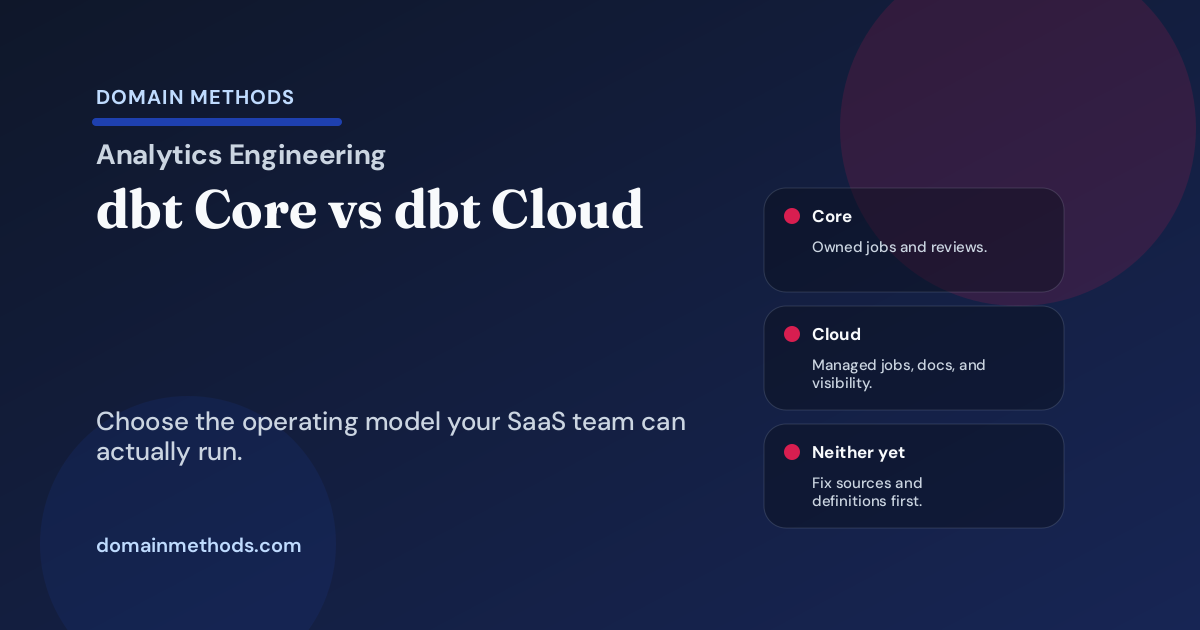
dbt Core is the open-source transformation framework. dbt Cloud is the managed product around dbt that adds hosted development, job scheduling, deployment visibility, permissions, documentation hosting, and collaboration workflows.
That simple definition matters because a lot of teams talk as if the choice is open source versus paid software.
It is really a choice between two operating models:
| Decision layer | dbt Core | dbt Cloud |
|---|---|---|
| Transformation logic | You write and run dbt projects yourself | You write dbt projects inside a managed workflow |
| Scheduling | You own orchestration or connect another scheduler | Managed jobs and deployment runs are built in |
| Environments | You design and maintain them | Cloud handles more of the environment pattern |
| Permissions | You enforce through repo, warehouse, scheduler, and process | Product-level controls help, depending on plan and setup |
| Documentation | You generate and host it yourself | Hosted docs are easier to expose and maintain |
| Observability | You assemble logs, alerts, and run visibility | More run visibility is available out of the box |
| Operating burden | Lower vendor cost, higher process burden | Higher platform cost, lower glue-work burden |
The mistake is treating that table as a procurement checklist.
A SaaS team does not get trust from hosted docs alone. It gets trust when somebody owns the definition, a change gets reviewed, a test catches the failure, and the stakeholder knows what changed before the board deck goes out.
When dbt Core Is Usually Enough
Core is a good fit when the team already has the habits that dbt Cloud would otherwise make easier.
That usually means:
- a data or analytics engineer can own orchestration without turning it into a side quest
- the team already uses pull requests and review discipline well
- production jobs are observable enough that failures do not hide for days
- documentation can be generated, hosted, and kept current without becoming a stale artifact
- permissions and warehouse access are already managed cleanly
- the first dbt use case is narrow enough that the operating surface is not complicated
This is common in teams with strong engineering support or a small but disciplined analytics engineering function.
The tradeoff is real. Core can look cheap on a software line item while quietly moving cost into staff time, brittle scripts, and one person knowing how the whole thing runs.
If your analytics lead is already the scheduler owner, model reviewer, stakeholder translator, release manager, and Slack support desk, “free” can get expensive fast.
When dbt Cloud Usually Makes More Sense
Cloud becomes more attractive when the project is important enough that the workflow around dbt needs to be visible, repeatable, and less dependent on glue work.
That usually shows up when:
- several analysts or engineers need to collaborate in the same project
- production runs support revenue, finance, lifecycle, attribution, or board reporting
- job failures need clear visibility instead of being buried in a scheduler nobody checks
- hosted documentation would help non-data teammates understand the modeled layer
- access control matters because more people are touching the project
- the company wants dbt to behave like a maintained business system, not a clever repo
The practical benefit is not that Cloud makes bad models good.
The benefit is that it lowers some of the operational friction around running dbt in a serious environment. That can be worth paying for when the alternative is a half-owned Core setup with invisible job failures and documentation nobody can find.
But buying Cloud before the operating model is clear can still waste money. It can make the project easier to run without making the project worth running.
The Comparison That Actually Matters
Here is the decision table I would use before choosing either path.
| Question | Core tends to fit when… | Cloud tends to fit when… |
|---|---|---|
| Who owns production runs? | engineering or data already owns orchestration well | the team needs a managed job and deployment workflow |
| Who reviews model changes? | pull-request discipline is already strong | analysts need a more guided development and deploy path |
| How visible are failures? | alerting and logs are already monitored | run visibility needs to be easier for the team to trust |
| How complex are permissions? | access is simple and governed elsewhere | more users, roles, or environments need product-level support |
| How will docs stay useful? | the team can host and maintain docs reliably | hosted docs make adoption and review easier |
| How fragile is the current stack? | the stack is simple and has a clear owner | too much hidden glue already depends on one person |
| How important is the first use case? | low-to-moderate risk, narrow scope | high-stakes reporting or recurring executive use |
Notice what is not in the table: brand preference.
A team with strong ownership can run Core cleanly. A team without ownership can make Cloud messy. The product can support a better workflow, but it cannot appoint the owner, settle the definition, or tell finance which revenue number wins.
When Neither Option Fixes the Real Problem
Sometimes the dbt Core vs dbt Cloud debate is a symptom.
The team is arguing about tooling because nobody wants to name the operating gap underneath it.
Common examples:
| What the team says | What may actually be wrong |
|---|---|
| “We need dbt Cloud so people trust the data” | The model definitions are still contested |
| “We should use Core because it is cheaper” | Nobody has priced the staff time needed to operate it well |
| “Our docs will solve stakeholder confusion” | The business definition is still unresolved |
| “The scheduler keeps failing” | Nobody owns the source freshness and incident path |
| “The data team needs better tooling” | The business has not agreed which decision the project supports |
This is where a tool decision can become a very polished avoidance mechanism.
If the CRM lifecycle stages are unreliable, neither Core nor Cloud will make the funnel trustworthy. If finance and RevOps disagree on what counts as expansion revenue, the dbt package will not settle it. If marketing wants attribution, sales wants pipeline source, and leadership wants one number for the board, the team needs a definition and ownership conversation before it needs another workflow screen.
That is why I would pair this comparison with How to Evaluate Whether Your Company Actually Needs dbt and Is Your dbt Project a Mess? A Health Scorecard. The first helps decide whether dbt is the right move at all. The second helps diagnose whether the project deserves trust once it exists.
A Practical Decision Sequence
Use this sequence before making the tool call.
1. Name the decision the dbt layer must improve
Do not start with “we need a better transformation workflow.” Start with the decision.
Examples:
- channel CAC and payback that growth and finance can both defend
- pipeline source reporting that sales, marketing, and RevOps will use in the same meeting
- lifecycle or activation reporting that product and GTM teams can act on
- board-ready revenue metrics that do not require a reconciliation sprint every month
If there is no decision, there is no useful dbt platform decision yet.
2. Map the current operating owner
Ask who owns the pieces around dbt:
| Operating area | Current owner | Risk if unclear |
|---|---|---|
| Source freshness | failures arrive as stakeholder surprises | |
| Model review | business logic changes without scrutiny | |
| Production jobs | silent failures or restart rituals | |
| Documentation | docs exist but nobody trusts or reads them | |
| Incident response | reporting breaks become ad hoc Slack archaeology | |
| Definition approval | the model formalizes a metric fight |
If every row points to one overloaded analyst, that is not an argument against dbt. It is an argument against pretending the operating model is solved.
3. Score the workflow gap
A simple rule helps:
- if the team has strong engineering ownership and the dbt footprint is narrow, start with Core
- if the team needs collaboration, managed jobs, hosted docs, and simpler production visibility, lean Cloud
- if the team cannot name owners, definitions, tests, and source precedence, pause the tool decision
That third option is the one teams skip. It is also the one that prevents wasted implementation work.
4. Prove the choice on one business-critical model
Do not roll out dbt as a broad platform promise.
Pick one model or mart that matters. For a SaaS company, good candidates are usually revenue, pipeline, lifecycle stage, customer health, activation, retention, CAC, or attribution.
Make that model decision-grade first:
- source path is known
- business definition is approved
- owner is named
- tests cover the failure modes people actually fear
- documentation explains the business use, not just columns
- the release path is visible
- stakeholders know what changed
Once that works, expand.
What I Would Choose in Common SaaS Scenarios
| Scenario | Likely choice | Why |
|---|---|---|
| One analyst, narrow reporting scope, clean warehouse | dbt Core or wait | Keep the operating surface small until complexity justifies more process |
| Small data team with engineering support and strong CI/CD | dbt Core | The team can own the missing platform pieces responsibly |
| Analytics team supporting revenue, finance, product, and board reporting | dbt Cloud | Managed jobs, docs, permissions, and visibility reduce operational drag |
| Several analysts need to collaborate without owning orchestration glue | dbt Cloud | The workflow support is likely worth more than the subscription savings |
| CRM and billing data are messy and definitions are contested | Neither yet | Fix source precedence and metric ownership before debating the dbt layer |
| Leadership wants AI-ready data but source trust is weak | Neither yet, then Data Foundation | AI readiness starts with governed source and model trust, not a tool checkbox |
The point is not that one option is mature and the other is naive.
The point is that each option assumes a different kind of operating maturity.
How This Connects to Data Foundation Work
A healthy dbt decision sits inside a larger foundation decision.
The company needs to know:
- which source wins when systems disagree
- which models support which decisions
- which tests protect the business from bad data
- who approves definition changes
- how incidents are handled
- how documentation stays close to the work
- which dashboards or workflows should change after a model ships
That is exactly where Data Foundation work belongs. The engagement is not “install dbt.” It is the operating layer around warehouse models, transformation logic, tests, ownership, and reporting people can defend.
When the bigger problem is that the business ask is still unclear, Translate the Ask is the better first move. You do not want a clean dbt project for a poorly defined decision.
Bottom Line
Choose dbt Core when your team can own the operating layer around dbt without hiding cost in heroics.
Choose dbt Cloud when the managed workflow, visibility, permissions, and collaboration support reduce real operational risk.
Choose neither yet when the team is still missing source trust, metric definitions, business ownership, or a specific decision the dbt layer must improve.
The best choice is the one your team can actually operate after launch.
dbt Core vs Cloud decision worksheet
Map the owner, workflow gaps, and first decision-grade model before you choose the dbt operating path.
Instant download. No email required.
Want future posts like this in your inbox?
This form signs you up for the newsletter. It does not unlock the download above.
Download the dbt Core vs Cloud decision worksheet
A lightweight worksheet for mapping the tool choice to owners, environments, permissions, tests, incidents, and the first decision-grade model.
DownloadNeed the dbt layer to hold up?
Data Foundation
Use the engagement when the real decision is source precedence, model design, testing, ownership, and reporting trust — not just which dbt package to run.
See Data FoundationIf the business ask is still fuzzy
Translate the Ask
Use the sprint when teams are debating tools before they have agreed on the metric, decision, owner, and operating requirement.
See Translate the AskSee It in Action
Common questions about dbt Core vs dbt Cloud
Is dbt Cloud always better than dbt Core for a SaaS team?
When is dbt Core enough?
When should a mid-size SaaS team lean toward dbt Cloud?
What does neither dbt Core nor dbt Cloud fix?
Should we choose dbt Core or dbt Cloud before hiring help?

About the author
Jason B. Hart
Founder & Principal Consultant
Helps mid-size SaaS companies turn messy marketing and revenue data into decisions leaders trust.