dbt and Reverse ETL: How to Turn Trusted Models Into Revenue Workflows
- Jason B. Hart
- Data Activation
- April 28, 2026
- Updated June 9, 2026
Table of Contents
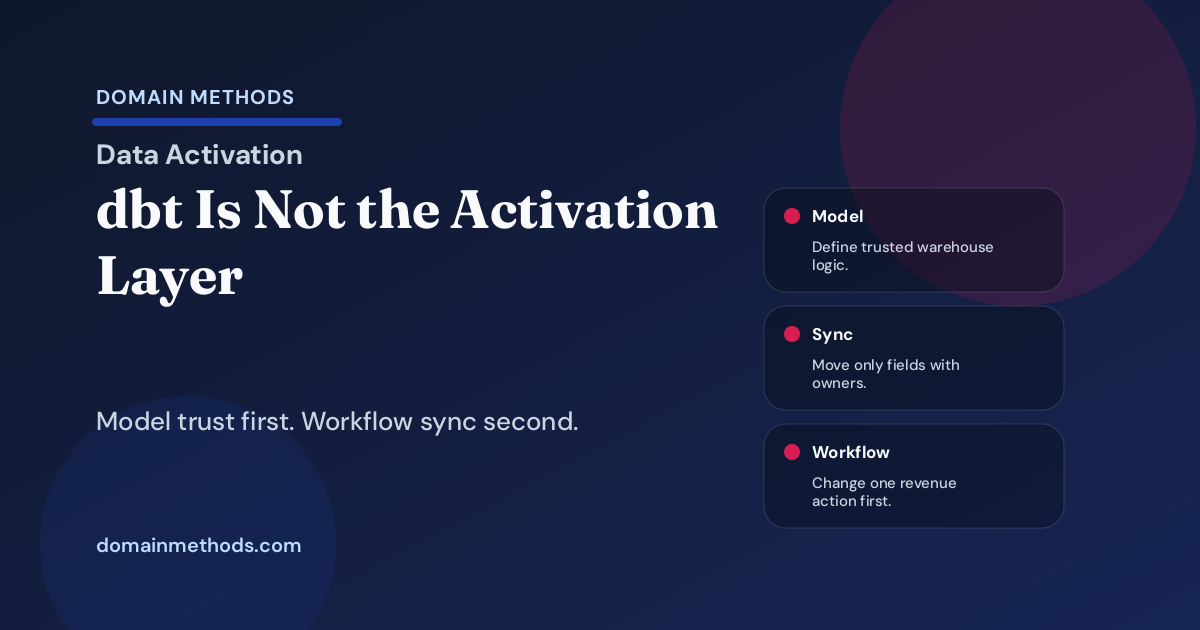
dbt Is Not the Activation Layer
dbt and reverse ETL solve different parts of the same operating problem. dbt helps a team model, test, document, and govern warehouse logic. Reverse ETL moves selected warehouse data into the systems where revenue teams work.
That distinction sounds obvious until a team starts buying tools.
A SaaS company gets its dbt project into decent shape. The warehouse has product usage, account history, lifecycle events, invoices, CRM activity, and a few modeled scores. Someone says, “We should push this into Salesforce.” Someone else says, “We need Hightouch.” Then the conversation jumps straight to destinations, sync limits, pricing tiers, and vendor demos.
The better first question is simpler: which workflow should change because this model exists?
If nobody can answer that, reverse ETL will not create strategy. It will only make unmade decisions travel faster.
Use this with the Modern Data Foundation and dbt Guide when the local dbt issue is really part of a larger source-of-truth, ownership, or analytics-engineering repair sequence.
What dbt Does in the Modern Data Stack
dbt is where many mid-size SaaS teams finally get business logic out of spreadsheets, dashboards, and one-off CRM formulas. It gives the data team a place to define transformations, write tests, document lineage, and make shared definitions visible.
In practical terms, dbt should help answer questions like:
- How do we calculate product-qualified accounts?
- Which source wins when CRM, billing, and product disagree?
- Which lifecycle stage definition is the one we trust?
- Which models feed executive reporting, segmentation, or sales routing?
- What tests should fail before a broken metric reaches the business?
That is valuable work. It is also not the same as activation.
A clean dbt model sitting in the warehouse does not automatically change a sales rep’s queue, a lifecycle marketer’s suppression logic, a customer-success team’s churn watchlist, or a product team’s onboarding intervention. The model may be trusted. The business still needs a delivery path.
If your dbt work is still mostly a documentation project, start with the trust problem first. I wrote about that in why treating dbt like documentation wastes the investment, and the short version is this: tests and docs matter because they change what the business can safely do, not because they make the project look mature.
What Reverse ETL Does That dbt Does Not
Reverse ETL takes modeled warehouse data and sends it into operational destinations. That can mean Salesforce, HubSpot, Marketo, Braze, Customer.io, Zendesk, ad platforms, product tools, or a support workflow.
The useful examples are concrete:
- a PQL score from dbt appears in Salesforce so sales can prioritize accounts
- churn-risk fields reach the customer-success platform before renewal panic starts
- lifecycle audiences sync into email or paid media tools with suppression logic attached
- expansion signals move into CRM fields that managers can inspect and coach against
- onboarding intervention flags reach the product or CS workflow while there is still time to act
That is the activation layer. It is not just “moving data.” It is moving a small amount of trusted data into a place where someone will do something differently.
This is why reverse ETL projects fail even when the sync technically works. The team pushes a warehouse field into the CRM, but sales does not trust it. Or marketing gets an audience, but the exclusion rule is unclear. Or CS sees a churn score, but nobody knows whether it is directional, decision-grade, or safe enough for escalations.
The connector did its job. The operating system around the connector did not.
Where Hightouch, Census, Polytomic, and Custom Syncs Fit
Hightouch, Census, Polytomic, and custom syncs all sit in the same broad conversation, but they are not interchangeable answers to every activation problem.
A vendor comparison is useful only after the workflow is specific enough to evaluate. If the question is “which tool has the most destinations?” you are probably early. If the question is “which tool can reliably sync account-level product usage and lifecycle exclusions into HubSpot and Salesforce with the ownership model we have?” now the comparison is real.
Use the existing comparison guides when the tool question is ready:
- Census vs Hightouch vs custom build for the broader reverse ETL tradeoff
- Hightouch vs Polytomic for PLG data activation when small-team workflow fit and PLG operations are the real concern
- Do you need a data activation tool? when the team is still deciding whether a dedicated platform is justified at all
The tool conversation should come after the model/workflow conversation. Otherwise you end up evaluating vendor strengths against a use case that keeps changing under your feet.
When dbt Plus Reverse ETL Is Healthy
A healthy dbt-plus-reverse-ETL setup has a boring feel to it. That is a compliment.
The model has tests. The destination field has a purpose. The owner is named. The business knows what should happen when the data lands. Failures are visible. Someone can explain whether a stale sync is an annoyance, a campaign risk, or a revenue-process incident.
Here is the working-session version:
| Healthy signal | What it means in operator language |
|---|---|
| The model has tests and freshness checks | The team knows when the source is no longer safe to act on |
| The key fields have owners | There is someone to call when the logic changes or breaks |
| The destination field has one purpose | The CRM or lifecycle tool does not become a junk drawer for every modeled attribute |
| The action owner is clear | Sales, marketing, CS, or product knows what to do with the field |
| Sync failures are monitored | Broken delivery is caught before the business makes decisions from stale data |
| Adoption is inspected | The team checks whether the workflow changed behavior, not just whether the sync ran |
One operator detail matters here: the first workflow should be small enough that people can remember it without opening a systems diagram. If it takes a 45-minute walkthrough to explain what is being synced, why it exists, and who acts on it, the workflow is probably too broad for the first activation pass.
When dbt Plus Reverse ETL Creates Risk
The risky version usually starts with enthusiasm.
The data team has a useful model. Growth wants audiences. Sales wants scoring. CS wants alerts. Product wants onboarding signals. Everyone wants the warehouse to show up in their tools. Nobody wants to make the hard choice about which workflow deserves the first governed path.
That is how teams turn activation into field sprawl.
Watch for these risk signals:
| Risk signal | What usually goes wrong |
|---|---|
| The dbt model logic is still changing weekly | The destination team loses trust because the field means something different every month |
| There is no metric or workflow owner | Every disagreement becomes a data-team support ticket |
| CRM already has conflicting fields | The sync adds one more version of truth instead of removing confusion |
| The request is “sync everything” | Nobody has decided which fields should change behavior |
| No one owns the downstream action | The model becomes visible, but the workflow does not improve |
| There is no rollback plan | A bad sync becomes an operational cleanup project instead of a contained incident |
This is the part teams underestimate. Bad reporting slows decisions. Bad activation can automate the wrong decision.
If an executive dashboard has a questionable PQL number, someone may challenge it in a meeting. If that same questionable PQL logic starts routing accounts, changing sales queues, suppressing lifecycle campaigns, or triggering customer outreach, the mess becomes operational.
How to Choose the First Activation Workflow
Do not start with the workflow that sounds most impressive. Start with the workflow where a trusted model can change a visible decision this quarter.
A good first workflow usually has five traits:
- Clear business pain. Someone can name the current operating problem without saying “data activation.”
- Known model inputs. The source tables and dbt models are understood enough to test.
- One primary destination. Salesforce, HubSpot, Braze, Customer.io, a CS platform, or one product surface.
- Named action owner. A team knows what they will do when the field lands.
- Containable failure. If the sync is wrong, the team can pause, rollback, or quarantine the impact.
Here are the workflows I would usually consider first for a SaaS team:
| Workflow | Good first version | Why it works |
|---|---|---|
| PQL routing | One account or lead score plus reason code in CRM | Sales can inspect and act without learning a new tool |
| Lifecycle suppression | A small audience table for customers, open deals, or recent converters | Marketing stops wasting spend or sending embarrassing messages |
| Churn-risk escalation | One health signal and one owner for follow-up | CS gets a timely prompt instead of another dashboard |
| Expansion signal | A usage or adoption threshold visible to account teams | Revenue teams see growth signals before the renewal deck |
| Onboarding intervention | A product milestone flag routed to CS or lifecycle | The team acts while behavior can still change |
The first workflow should teach you whether your activation muscle is real. If it works, expand. If it struggles, you have learned where the operating weakness lives: model trust, identity matching, destination ownership, QA, adoption, or prioritization.
Checklist Before Pushing dbt Models Into CRM or Lifecycle Tools
Use this before the first sync goes live.
| Question | Pass condition |
|---|---|
| Is the model tested? | Core uniqueness, freshness, accepted-values, and relationship checks are in place for the fields that matter |
| Is the field owner named? | One business or RevOps owner can approve meaning changes |
| Is entity matching understood? | Account, user, lead, contact, and opportunity joins are explicit enough to explain |
| Does the destination field have a job? | The field supports a named action, segment, route, alert, suppression, or decision |
| Is the action owner named? | The team receiving the field knows what to do and when to ignore it |
| Is failure visible? | Sync failures, stale fields, and unexpected volume changes are monitored |
| Is rollback possible? | There is a practical way to pause, revert, or quarantine a bad sync |
| Is adoption checked? | Someone will inspect whether the workflow changed behavior after launch |
If several rows fail, you probably do not have a reverse ETL problem yet. You have a readiness problem.
That does not mean stop. It means route the work correctly. Use Data Foundation when the source logic, dbt tests, ownership, or entity matching is still too brittle. Use Data Activation when the model is trusted enough and the next hard part is getting it into revenue workflows safely.
Reverse ETL Evaluation Matrix
Compare Census, Hightouch, and custom syncs after you have named the workflow, model owner, destination, and QA path.
Instant download. No email required.
Want future posts like this in your inbox?
This form signs you up for the newsletter. It does not unlock the download above.
The Point Is Not More Syncs
The goal is not to make the warehouse louder.
The goal is to make one trusted model change one operating workflow, then build from there.
That is the difference between a useful activation layer and another expensive integration surface. dbt should help the team decide what is trustworthy. Reverse ETL should help that trusted logic reach the place where work happens. Everything else is just plumbing with a nicer dashboard.
Download the Reverse ETL Evaluation Matrix (PDF)
A practical worksheet for comparing Census, Hightouch, and custom syncs once the workflow, model owner, destination, and QA path are clear.
DownloadReady to operationalize the model?
Data Activation
Use Data Activation when the workflow is clear and the team needs trusted warehouse logic pushed into CRM, lifecycle, sales, support, or product systems without creating another brittle handoff.
See Data ActivationModels still not trusted enough?
Data Foundation
Start with Data Foundation when source precedence, dbt tests, ownership, or identity logic still need cleanup before activation is safe.
Strengthen the foundationSee It in Action
Common questions about dbt and reverse ETL
Is dbt a reverse ETL tool?
Do we need reverse ETL if our dbt models are already good?
Should we compare Hightouch, Census, or Polytomic before fixing dbt quality?
What is the best first dbt plus reverse ETL workflow for a SaaS team?
When should this route to Data Activation instead of Data Foundation?

About the author
Jason B. Hart
Founder & Principal Consultant
Helps mid-size SaaS companies turn messy marketing and revenue data into decisions leaders trust.