Data Audit vs Translation Sprint vs Full Warehouse Rebuild
- Jason B. Hart
- Data Strategy
- April 21, 2026
- Updated May 15, 2026
Table of Contents
Should you start with a data audit, a translation sprint, or a full warehouse rebuild?
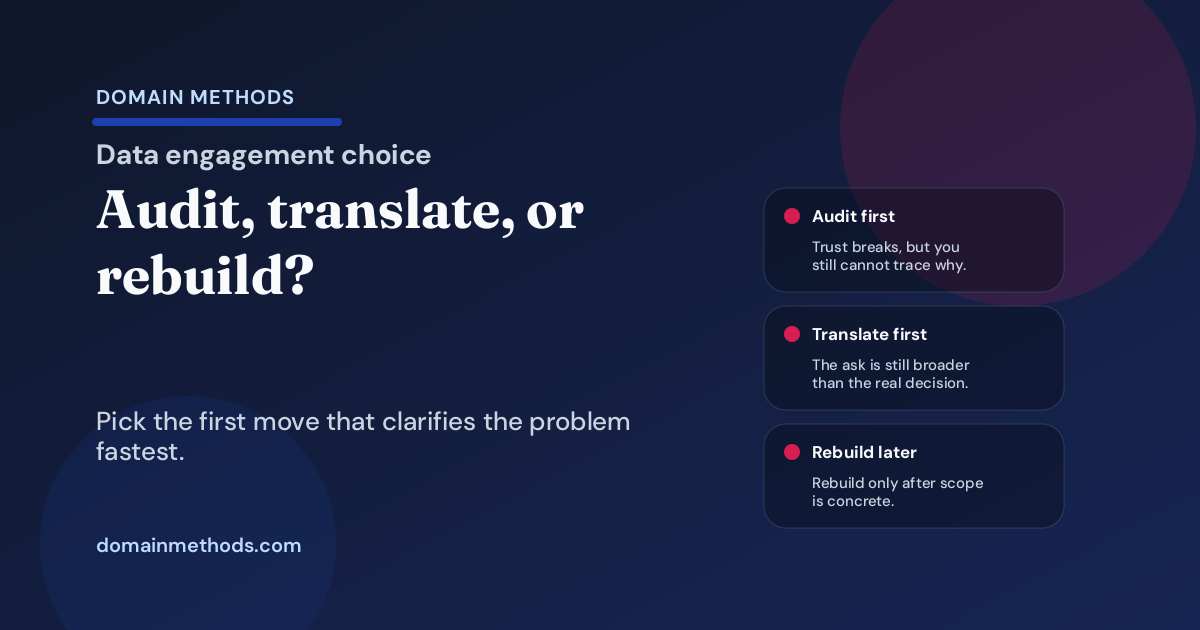
Start with the smallest move that improves decision quality fastest. If the team cannot yet describe the problem cleanly, do not jump to a rebuild. If the ask is clear but the evidence path is not, start with diagnosis. If the architecture debt is already obvious and well-scoped, then deeper implementation may finally be worth it.
That sounds less dramatic than “we need to rebuild the stack.”
It is also how expensive cleanup projects avoid becoming six-week detours with no cleaner answer at the end.
A lot of mid-size SaaS teams know they have a real data problem well before they know what kind of help they should buy first. The board deck keeps picking up caveats. Spend reviews turn into source fights. Marketing wants better reporting. RevOps wants cleaner rules. The data team wants fewer vague requests. Everyone is describing a real pain point, but not the same layer of the problem.
That is the moment where teams overspend.
They buy a rebuild because the mess feels systemic. They order an audit when the real problem is that nobody translated the business ask into a tractable scope. They run a workshop that sharpens the language but leaves the brittle joins untouched. The project starts wide, the meeting count goes up, and the original question is still unresolved.
This guide is for the earlier choice: what kind of engagement should come first when the problem is real but the scope is still messy?
It sits next to, but does not duplicate, How to Audit Your Marketing Data in Two Days and What You’ll Probably Find, How to Tell Whether You Have a Tools Problem or a Foundation Problem, How to Scope a Data Foundation Cleanup Before You Hire Anyone, and The Single Source of Truth Blueprint. Those pieces help with diagnosis, problem-shape sorting, hiring prep, or longer-term rollout. This one answers the narrower buyer question: what should we do first?
Why teams pick the wrong first move
Most bad engagement choices do not come from laziness. They come from compression.
Leadership wants a cleaner answer before the next board conversation. Marketing wants the spend story to stop wobbling. RevOps wants fewer field-level surprises. The data team is tired of rebuilding outputs for asks that were never scoped properly in the first place.
Under pressure, those very different needs get collapsed into one sentence: “We need to fix the data.”
That sentence hides at least four distinct situations:
- the ask is still fuzzy, political, or overloaded, so the team needs a translation sprint before it can buy the right work
- the ask is clear enough, but nobody can tell where trust breaks, so the team needs a real audit
- the failure layer is already visible, and the systems debt is concrete enough that implementation should start
- the company is still too vague for any of the above and needs a stop-and-scope reset before it buys another lane
One operator detail matters here: the team that shouts loudest is not always pointing at the first failure layer. Finance might feel the pain in the board pack, but the break could live in CRM handoffs. Marketing might blame the warehouse, but the real issue could be that the request was never translated into a stable metric brief. Data might ask for a rebuild because the current models are brittle, while leadership is still changing what question the report is supposed to answer every two meetings.
That is why the first move should be chosen by failure pattern, not by who is most frustrated.
What each engagement is actually for
Before you compare options, name what each lane is meant to do.
A data audit
A data audit is diagnosis work.
It is the right first move when the business question is real enough, but the team cannot yet trace where the answer stops being trustworthy. You are trying to find the trust break, not solve every downstream consequence in one pass.
A good audit usually answers questions like these:
- Where does source context disappear?
- Which fields, syncs, or lifecycle steps keep breaking trust?
- Which report caveats are upstream evidence problems versus downstream interpretation problems?
- What can be fixed quickly, and what points toward deeper architecture work?
An audit is useful when the room already believes the problem lives in the evidence path but still needs proof.
A translation sprint
A translation sprint is request-shaping work.
It is the right first move when the team keeps asking for outputs before it has agreed on the decision, the owner, the reporting artifact, or the confidence level required. The problem may still include data debt, but the first blocker is ambiguity in the ask.
A good translation sprint usually answers questions like these:
- What decision is this work supposed to support?
- Who is the real audience?
- What level of trust is actually required: directional, decision-grade, or leadership-grade?
- Which input systems matter now, and which can wait?
- What should the first deliverable be: dashboard, decision brief, cleanup sprint, workflow, or deeper build?
This is the lane teams skip when they are tired of messy meetings. Ironically, it is often the move that prevents one more messy implementation cycle.
A full warehouse rebuild
A warehouse rebuild is implementation work.
It is the right first move when the scope is already concrete, the architecture debt is visible, and the team can point to the models, joins, data contracts, sync behavior, reporting logic, or workflow handoffs that must be repaired for the answer to stay trustworthy.
A real rebuild lane usually means the room can already say:
- what decision path needs durable support
- which systems are involved
- what logic is brittle or duplicated
- which owner expectations must hold after the build
- what a first implementation win should change in a real meeting or workflow
If the team cannot say those things yet, calling the next move a rebuild is usually just a way of paying for unresolved ambiguity with more engineering time.
The comparison at a glance
| Option | Best when | Scope clarity needed | Time-to-value | Common failure mode | What it does not solve |
|---|---|---|---|---|---|
| Data audit | The business question is real, but the trust break is still hidden in fields, handoffs, syncs, or reporting lineage | Medium | Fast to medium | The team mistakes diagnosis for implementation and expects the audit alone to fix the operating model | It does not settle a fuzzy ask or rebuild brittle architecture by itself |
| Translation sprint | The room is still mixing business pressure, reporting requests, ownership gaps, and tool opinions into one vague project | Low to medium | Fast | The sprint is skipped, so the team buys delivery work before the brief is stable | It does not repair broken models or source systems on its own |
| Full warehouse rebuild | The failure layer is already concrete and the systems debt is clear enough to implement against | High | Medium to slower | The rebuild starts too early and becomes a giant discovery exercise with code attached | It does not clarify what question the business actually needs answered |
| Stop and scope first | Nobody can name the decision, first success condition, owner, or leading failure layer yet | Very low | Fast if leadership is willing to decide | The team treats urgency as a reason to skip scoping | It does not generate a new artifact yet, but it prevents expensive thrash |
That last row matters.
A lot of teams pretend they have to choose among three real lanes when none of the three has earned the right to start yet.
Choose a data audit first when the team needs evidence, not a bigger story
Start with an audit when the room can already describe the pain but still cannot point to where trust breaks.
Common signs:
- the same KPI behaves differently across reports and nobody can trace why
- campaign or lifecycle context seems to disappear between systems
- one team trusts the CRM story less than the ad-platform story, but nobody can prove where the mismatch starts
- every meeting includes caveats like “we think this is directionally right” without anyone showing why
An audit is especially useful when you suspect there is a real technical problem, but the team keeps debating symptoms instead of evidence.
That is why How to Audit Your Marketing Data in Two Days and What You’ll Probably Find is adjacent here. If you already know you need diagnosis, that guide helps you run it. This article handles the decision before that one: whether diagnosis is the right lane at all.
One practical operator test: if you can name the report, the metric family, and the trust complaint, but still cannot tell whether the break lives in capture, syncs, model logic, or artifact handoff, the audit lane has probably earned priority.
Choose a translation sprint first when the ask is the real mess
Start with a translation sprint when the team keeps asking for a solution before it has framed the problem well enough to solve.
Common signs:
- the same request keeps arriving as dashboard, cleanup, tooling, and strategy work all at once
- leaders agree the current answer is not good enough, but not what the next answer should look like
- teams are using different confidence bars without saying so
- one function wants a board-safe answer while another really needs a directional operating view
- engineering or analytics keeps inheriting asks that are broad, urgent, and structurally underdefined
This is the lane people under-buy because it sounds less tangible than an audit or rebuild.
But it is often the highest-leverage first move when the company does not yet have a real operating brief.
A translation sprint gives the business something many projects quietly lack: a shared description of the decision, owner, artifact, scope boundary, and confidence threshold. That is what lets an audit stay focused or a rebuild stay honest.
One lived-in detail from teams in this stage: the same Slack thread often contains three different requests without anyone noticing. Someone wants a dashboard, someone else wants better source governance, and someone else wants the numbers ready for the next board meeting. If nobody separates those, the project starts bloated and still somehow underspecified.
Choose a full warehouse rebuild first only when the debt is already concrete
A rebuild should be first only when the ambiguity tax has already been paid.
That means the team can point to durable implementation work such as:
- warehouse models that encode conflicting business logic
- dbt jobs or transformations that are brittle enough to keep undermining reporting trust
- source-system and warehouse handoffs that need structural repair, not one more diagnosis pass
- duplicated reporting logic across tools that now needs one governed implementation path
- workflow outputs that depend on deeper architecture cleanup before anyone can trust them
This is where pieces like How to Scope a Data Foundation Cleanup Before You Hire Anyone and The Single Source of Truth Blueprint become more relevant. Once the problem is scoped and the architecture debt is visible, broader foundation work becomes easier to justify and harder to turn into theater.
The mistake is choosing a rebuild because the organization is tired.
Fatigue is real. It is just not the same thing as implementation readiness.
If the rebuild team would still need to spend its first month deciding what the question is, who owns the answer, and which trust bar matters, then the rebuild is not the first move. It is the second or third move being purchased too early.
When none of the three is the right answer yet
Sometimes the best answer is to stop and scope before you buy any lane.
That is not indecision. It is containment.
Choose the stop-and-scope reset when:
- nobody can name the one decision that should improve first
- the room is mixing staffing, tooling, governance, dashboards, and board reporting into one shapeless project
- no one can say which layer leads: definitions, source systems, model logic, or workflow ownership
- the expected success condition still sounds like “make the data better”
- every option feels plausible because the current brief is still too vague to rule anything out
In practice, this reset can be short. Sometimes it is one working session. Sometimes it is a focused translation sprint. The point is not to add ceremony. The point is to stop paying implementation rates for discovery that leadership has not finished doing.
A practical scoring frame for the next working session
If you want to settle this quickly, score each path against the same questions.
Score a data audit higher when:
- the business question is clear enough to inspect
- the team can point to one report or metric family under pressure
- the evidence path is suspect, but the exact break is still unclear
- you need diagnosis before you choose the build lane
Score a translation sprint higher when:
- the ask still changes depending on who is talking
- the team cannot agree on the right artifact, confidence level, or owner
- engineering or analytics keeps inheriting broad requests with weak problem framing
- a sharper brief would make every later move more efficient
Score a full warehouse rebuild higher when:
- the problem statement is already concrete
- the technical debt is visible enough to implement against
- the owners, systems, and success condition are already named
- more discovery would mostly confirm work the team already understands
Score stop-and-scope first higher when:
- the room cannot answer basic scoping questions yet
- each proposed lane still contains major hidden assumptions
- leadership urgency is real, but the brief is still too blurry for good buying decisions
- the first win has not been named in a way anyone could observe in a real meeting
Use this simple decision table if the room is stuck
| If this is true… | Start here |
|---|---|
| “We know the report is wrong, but not where trust breaks.” | Data audit |
| “We keep requesting outputs before agreeing on the decision or artifact.” | Translation sprint |
| “We already know the systems debt and can name what needs implementation.” | Full warehouse rebuild |
| “We still cannot describe the problem cleanly enough to buy the right work.” | Stop and scope first |
That table will not replace judgment.
It will stop a very common failure mode: buying the biggest lane because it feels like the most serious response.
Download the worksheet and pressure-test the first move
If you want to run this with leadership, RevOps, marketing, or the data team in one session, use the worksheet below to score the first move honestly.
Download the Data Engagement First-Move Worksheet (PDF)
A practical worksheet for scoring whether the next move should be a data audit, translation sprint, rebuild, or a stop-and-scope reset before the project sprawls. Download it instantly below. If you want future posts like this in your inbox, you can optionally subscribe below.
Instant download. No email required.
Want future posts like this in your inbox?
This form signs you up for the newsletter. It does not unlock the download above.
Bottom line
A data audit is for hidden trust breaks. A translation sprint is for hidden ambiguity in the ask. A warehouse rebuild is for visible implementation debt. And sometimes the smartest first move is admitting you are still too vague for any of the three.
If the room still cannot name the decision, owner, trust bar, and first success condition, start with Translate the Ask. If the ask is finally clear and the architecture debt is the blocker, move into Data Foundation. The expensive mistake is treating those lanes like synonyms.
Download the Data Engagement First-Move Worksheet (PDF)
A practical worksheet for scoring whether the next move should be a data audit, translation sprint, rebuild, or a stop-and-scope reset before the project sprawls.
DownloadIf the problem is real but the ask is still fuzzy
Translate the Ask
Use the sprint when leadership knows the reporting pain is expensive but still keeps describing the next move as some vague mix of dashboards, cleanup, tooling, and governance.
See the translation sprintIf the evidence path and architecture debt are finally clear
Data Foundation
Use the deeper engagement when the team can already name the systems, logic, and ownership debt that must be repaired to support trustworthy answers.
See Data FoundationSee It in Action
Common questions about choosing the first data engagement
When is a data audit the right first move?
When is a translation sprint better than an audit?
When is a warehouse rebuild actually justified?
What if none of the three options feels right yet?

About the author
Jason B. Hart
Founder & Principal Consultant
Helps mid-size SaaS companies turn messy marketing and revenue data into decisions leaders trust.