CDP vs Reverse ETL vs Warehouse-Native Activation: Which Architecture Fits Your SaaS Team?
- Jason B. Hart
- Data Activation
- April 25, 2026
- Updated June 9, 2026
Table of Contents
CDP vs reverse ETL vs warehouse-native activation: the real decision
The right data activation architecture is the one your team can operate after the demo is over. For most mid-size SaaS teams, the choice is not simply CDP vs reverse ETL vs custom build. It is a question of where trusted customer logic should live, who owns the workflow, and how much operational risk the team is prepared to carry.
I see this decision go sideways when a buyer says “we need activation” and each function hears something different. Marketing hears audiences. RevOps hears CRM fields. Product hears lifecycle triggers. Data hears modeled tables and governance. Security hears consent and suppression risk. All of them may be right, but they are not choosing the same architecture yet.
This guide is meant to make the architecture conversation more practical. It will not tell you that one category always wins. It will help you choose the operating shape that fits your use case, maturity, and ownership model.
If the first question is still “what is the first workflow worth shipping?” start with Do You Need a Data Activation Tool? or the broader Data Activation Playbook. If the team is already comparing Hightouch, Census, and custom reverse ETL, read the more specific Census vs Hightouch comparison. This article sits one layer above that: which architecture pattern fits the business problem?
Use this alongside the Data Activation Playbook when the real decision is how trusted warehouse logic should reach CRM, lifecycle, sales, customer-success, or AI workflows safely.
The three activation patterns in plain English
A lot of tool evaluations get harder because the categories are fuzzy. Use these working definitions before the vendor shortlist starts.
| Pattern | Plain-English definition | Usually owned by | Strongest fit |
|---|---|---|---|
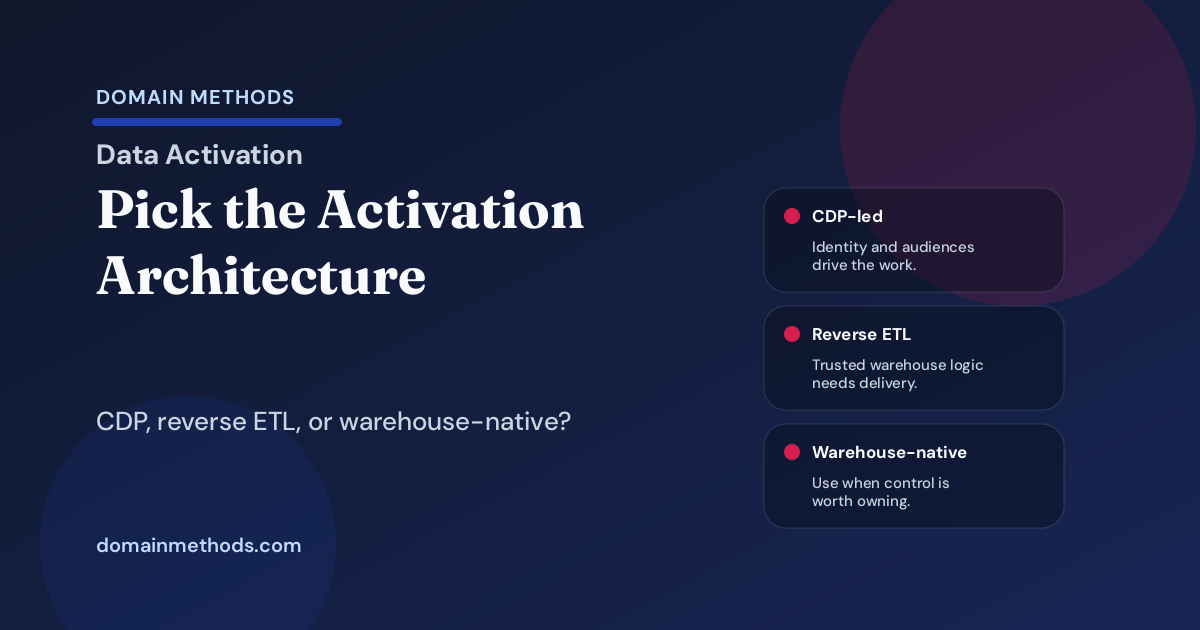
| CDP-led activation | A customer-profile layer collects, resolves, segments, and pushes customer data into marketing or customer systems | Marketing operations, growth, lifecycle, sometimes data | Teams that need identity collection, audience management, consent handling, and marketer-friendly segmentation |
| Reverse-ETL-led activation | Governed warehouse models are synced into CRM, ad, lifecycle, support, or product systems | Data, analytics engineering, RevOps, lifecycle operations | Teams that already trust warehouse logic and need reliable delivery into operational tools |
| Warehouse-native/custom activation | The warehouse and internal services become the activation layer, often with custom jobs, APIs, or embedded product workflows | Data engineering, platform, product engineering | Teams with unusual workflows, strict control needs, or product-led surfaces that generic connectors do not handle well |
The difference is not just technical. It changes where definitions live, who can change them, how failures are monitored, and who gets paged when a bad audience or field reaches the business.
CDP vs reverse ETL vs warehouse-native activation comparison
Use this table to keep the meeting honest. If one row is still unknown, do not hide it under product features.
| Decision lens | CDP-led activation | Reverse-ETL-led activation | Warehouse-native/custom activation |
|---|---|---|---|
| Best-fit use cases | Web/app collection, identity stitching, campaign audiences, consent-aware marketing journeys | CRM enrichment, lifecycle audiences from warehouse models, product-qualified account routing, CS health fields | Product surfaces, internal workflow automation, unusual data products, regulated or highly specific activation logic |
| Team ownership | Marketing operations or lifecycle team, with data support | Data/analytics engineering plus RevOps or lifecycle owner | Data engineering, platform engineering, product engineering |
| Data-model maturity required | Medium. Can collect and segment early, but still needs clear definitions for serious GTM use | High. The warehouse logic must be trusted enough to expose downstream | Very high. Internal teams own modeling, delivery, QA, and support |
| Speed to first workflow | Fast when collection and destination connectors are standard | Fast when the warehouse model and destination mapping already exist | Slower unless the internal platform already supports the pattern |
| Governance and consent risk | Can be strong if consent and identity rules are configured carefully; dangerous if marketing treats it as a sandbox | Strong when warehouse governance is real; brittle if teams sync fields before definitions settle | Strongest control, highest ownership burden |
| Maintenance burden | Vendor configuration, taxonomy discipline, profile rules, destination QA | Model quality, sync monitoring, field mapping, destination QA | Connectors, APIs, retries, monitoring, security, schema drift, support |
| Common failure mode | The CDP becomes a second source of truth with marketer-managed segments nobody audits | Reverse ETL becomes another sync layer nobody owns after launch | Custom activation becomes invisible infrastructure maintained by one overextended engineer |
The pattern that wins should match the workflow you are willing to own, not the category that sounds most modern.
When a CDP is the wrong answer
A CDP is useful when the team needs customer-data collection, identity resolution, audience management, consent-aware activation, and a business-friendly way to build segments. That can be exactly right for lifecycle and ecommerce-style use cases.
It is the wrong answer when the real problem is source-of-truth conflict.
If sales, marketing, product, and finance still disagree on lifecycle stage, account ownership, customer status, or what counts as an active product signal, a CDP will not magically settle that argument. It may make the argument worse by creating a new place to define the same audience.
The operator-level warning sign is simple: the CDP project starts with a destination list instead of a definition workshop. Someone says, “we need audiences in five tools,” but nobody can explain which audience should change which decision. That is how teams buy a shiny activation layer and still run the weekly meeting from a spreadsheet.
Choose a CDP when the customer-profile and audience-management layer is genuinely the missing capability. Do not choose it because the warehouse, CRM, and marketing teams are tired of agreeing on definitions.
When reverse ETL is enough
Reverse ETL is often the cleanest answer for a warehouse-first SaaS team. The logic stays where the business definitions already live, and the activation layer moves the result into the systems where teams work.
That works especially well when:
- the warehouse already contains trusted customer, account, product, and lifecycle models
- the first workflow has a clear destination, such as Salesforce, HubSpot, Braze, Marketo, or an ad platform
- the business wants operational fields or audiences, not another segmentation workbench
- data and RevOps can agree on field ownership, freshness, QA, and failure response
The trap is thinking reverse ETL is “just syncs.” It is never just syncs once the business depends on it. Somebody needs to own mapping changes, null handling, failed jobs, source-model drift, backfills, and the awkward moment when a downstream team asks whether a field is safe to use in a campaign or sales play.
Reverse ETL is enough when the workflow is clear and the warehouse is trusted. It becomes another problem when the team uses it to avoid deciding what should be activated and who owns the outcome.
When warehouse-as-CDP or custom activation is justified
Warehouse-as-CDP or custom activation makes sense when the workflow is important enough, specific enough, or controlled enough that generic activation tooling becomes the constraint.
That might mean:
- product-led workflows where signals need to reach the app, not just a CRM or ad platform
- internal routing, scoring, or eligibility logic that is too specific for vendor-side configuration
- strict security, consent, suppression, or audit requirements
- multi-surface workflows where the same decision reaches product, sales, lifecycle, and customer success systems
- a mature platform team that already owns internal data products and operational services
The cost is real. Custom activation means the company owns reliability, monitoring, retries, schema drift, documentation, and support. It also means the business can no longer blame the vendor when a field is wrong. The owner is in the building.
That is sometimes the right trade. But it should be a deliberate architecture decision, not a quiet attempt to avoid vendor spend.
Do not buy yet if these are still unresolved
There is a useful sentence to say before any activation purchase: “If this went live next month, what decision would change?”
If the answer is vague, do not buy yet.
Hold the architecture decision until these basics are clear:
| Unresolved question | Why it blocks the architecture decision | Better next move |
|---|---|---|
| What is the first workflow? | CDP, reverse ETL, and custom all look plausible until the use case is specific | Pick one workflow with a clear owner, destination, and business decision |
| Which source is trusted? | Activation amplifies source conflict; it does not resolve it | Stabilize the customer, account, lifecycle, or product model first |
| Who owns the downstream action? | A synced field without an operator becomes reporting theater | Assign the team that will use, QA, and improve the workflow |
| What consent or suppression rules apply? | Bad activation can create compliance and customer-experience risk fast | Define consent, exclusion, and suppression rules before syncing anything |
| What happens when the sync is wrong? | Failure response is part of the operating model, not a nice-to-have | Name the escalation owner and acceptable rollback path |
This is where Translate the Ask can be more valuable than another tool demo. If the cross-functional ask is still messy, translate it before you operationalize it.
Download the Data Activation Architecture Scorecard (PDF)
Score CDP-led, reverse-ETL-led, and warehouse-native activation against workflow clarity, source readiness, ownership, compliance risk, and maintenance burden before the next architecture or vendor meeting.
Instant download. No email required.
Want future posts like this in your inbox?
This form signs you up for the newsletter. It does not unlock the download above.
A simple scoring model for the architecture choice
Use the downloadable scorecard in a working session, but the core logic is straightforward.
Score each dimension from 1 to 5:
| Dimension | What a low score means | What a high score means |
|---|---|---|
| Workflow clarity | The team has a broad activation ambition but no named first use case | One workflow, owner, destination, decision, and success measure are clear |
| Source readiness | Definitions are unstable or spread across CRM, warehouse, product, and marketing tools | Trusted source tables and business rules already exist |
| Ownership durability | One person is informally translating and babysitting the work | Clear owners exist for logic, mapping, QA, and downstream adoption |
| Destination complexity | One low-risk destination with limited fields | Many systems, objects, refresh cadences, permissions, and failure paths |
| Compliance and suppression risk | Minimal regulated or consent-sensitive exposure | Consent, exclusion, identity, and customer-experience risks are material |
| Internal engineering capacity | Little appetite to own operational plumbing | A durable team can support internal services and failure response |
The pattern usually falls out quickly:
- If workflow clarity is low, do not buy yet.
- If source readiness is high and destinations are standard, reverse ETL often wins.
- If identity, collection, consent, and marketer-friendly audiences dominate the need, CDP-led activation may fit.
- If destination complexity, control needs, and engineering capacity are all high, warehouse-native/custom activation can be worth it.
The point is not to turn the decision into math. The point is to stop the loudest function from choosing the architecture for everyone else.
The practical recommendation for mid-size SaaS teams
For most mid-size SaaS teams, I would not start with a grand activation architecture.
I would start with one operational workflow that leadership already cares about. A PQL field in the CRM. A lifecycle audience that changes paid spend. A churn-risk signal in the CS workflow. A suppression rule that keeps the team from wasting money on the wrong accounts.
Then I would ask where the trusted logic should live and who will own the outcome after launch.
If the warehouse is already the trusted source, reverse ETL is often the fastest durable path. If the team needs collection, profile resolution, consent-aware audiences, and business-user segmentation, a CDP can be the right layer. If the workflow is product-led, unusual, or tightly controlled, warehouse-native/custom activation may be justified.
But if the team cannot name the workflow, owner, source of truth, and failure path, the architecture answer is not CDP, reverse ETL, or custom.
The answer is: stop buying and clarify the operating decision first.
Where to take this next
The useful follow-up is not another vendor shortlist. It is deciding which operating constraint should own the architecture choice:
- If a named workflow is ready and the question is implementation, start with Data Activation.
- If the team still cannot agree which workflow deserves the quarter, use The $500K Question before buying another layer.
- If you need proof that activation works when it is tied to a real handoff, read the PLG churn activation case study.
Sources and further reading
Download the Data Activation Architecture Scorecard (PDF)
A lightweight scorecard for choosing between CDP-led, reverse-ETL-led, and warehouse-native activation based on use case, ownership, readiness, and risk.
DownloadReady to ship the workflow?
Data Activation
Use the implementation service when the team knows which workflow matters and needs warehouse, product, or customer data activated into GTM systems.
See Data ActivationStill translating the ask?
Translate the Ask
Use the translation service when the blocker is not the tool category but getting business, RevOps, product, and data aligned on the use case.
See Translate the AskSee It in Action
Common questions about data activation architecture
What is the difference between a CDP and reverse ETL?
When is warehouse as CDP a better fit than buying a standalone CDP?
Can a mid-size SaaS team use both a CDP and reverse ETL?
What is the biggest mistake in data activation architecture decisions?

About the author
Jason B. Hart
Founder & Principal Consultant
Helps mid-size SaaS companies turn messy marketing and revenue data into decisions leaders trust.