Campaign Taxonomy and UTM Governance Checklist
- Jason B. Hart
- Marketing Analytics
- May 11, 2026
- Updated May 18, 2026
Table of Contents
What Is Campaign Taxonomy and UTM Governance?
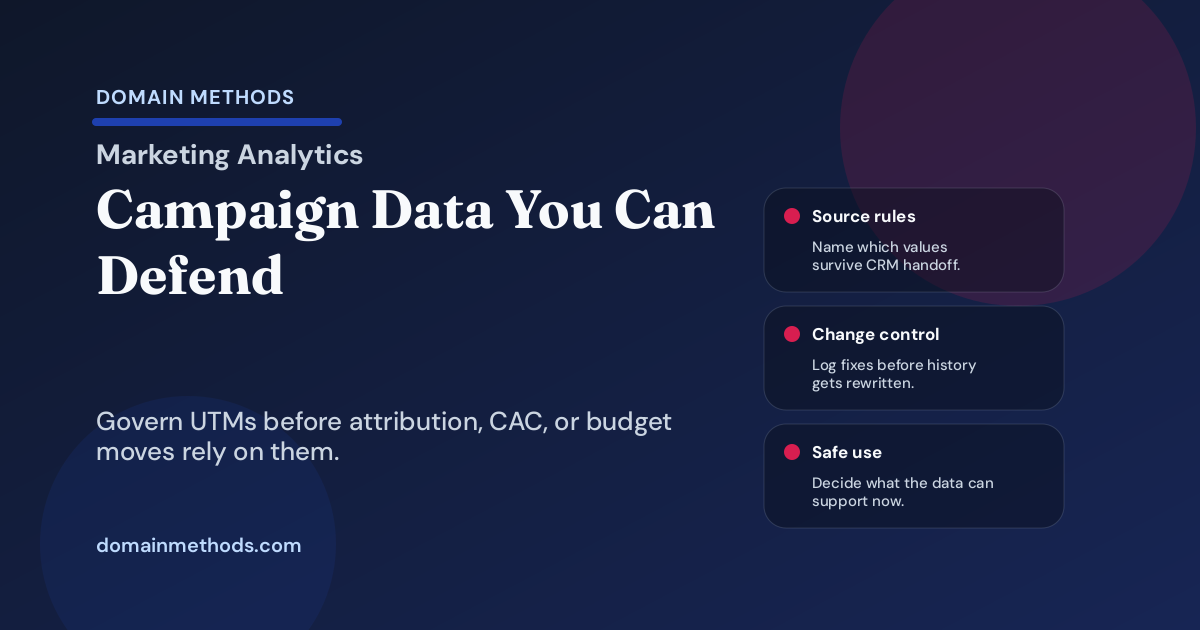
Campaign taxonomy and UTM governance is the operating agreement that decides how campaign activity is named, captured, handed off, changed, and trusted before it becomes an attribution or spend decision.
This is not a cosmetic cleanup project.
A mid-size SaaS team can have clean-looking dashboards and still have campaign data that falls apart the moment someone asks which channel earned more budget. Paid search might use one source convention, paid social another, partner campaigns a third, and CRM campaigns a fourth. The numbers still roll up into a chart, but the chart is built on private translations.
That is when the meeting gets expensive. Marketing explains the platform view. RevOps explains the CRM view. Finance asks whether the pipeline number ties to revenue. Somebody remembers that campaign names changed halfway through the quarter. The team does not have an attribution debate yet. It has a campaign-governance problem upstream of attribution.
If the broader question is whether attribution evidence is safe enough for a decision, use The Attribution Confidence Benchmark. If the immediate issue is choosing whether to fix instrumentation, definitions, or software first, read Fix Instrumentation First vs. Fix Definitions First vs. Buy Attribution Software First.
When the team is ready to connect campaign governance into the full attribution build, the Marketing Attribution Playbook for Mid-Size SaaS is the canonical sequence, and SaaS Marketing Attribution Services is the implementation path. This checklist sits one layer earlier: can the campaign data survive the handoff from launch to revenue reporting?
Start with the decision, not the naming spreadsheet
The fastest way to make UTM governance too big is to start with every possible field.
Start with one decision the business needs to make:
- move paid budget between campaign families
- explain CAC by source or offer
- defend whether a channel contributed to pipeline
- prepare a board narrative about demand creation
- decide whether a holdout or incrementality test is ready
- compare partner-sourced, paid, email, and organic campaign performance
Now the taxonomy has a job. It does not need to satisfy every future dashboard. It needs to be reliable enough for the decision in front of the business.
A useful working sentence sounds like this:
We are testing whether campaign source and UTM data are governed well enough to move budget next month without manually rebuilding the spend story.
That sentence changes the conversation. Instead of debating whether every label is perfect, the team can ask which fields must be controlled, which fields only need mapping, and which reporting uses are still unsafe.
The minimum viable campaign taxonomy
A practical taxonomy needs enough structure to connect launch intent to revenue reporting. It does not need twenty fields if eight do the work.
| Field | What it answers | Governance test |
|---|---|---|
| Source | Where did the traffic or lead originate? | Are values controlled across paid, organic, partner, referral, and direct capture? |
| Medium | What type of motion carried the traffic? | Do teams use consistent channel mechanics such as paid search, paid social, email, webinar, partner, or organic? |
| Campaign family | What business initiative does this belong to? | Can leadership compare related campaigns without hand-rolled grouping? |
| Offer or asset | What was promoted? | Can the team tell whether the offer, not just the channel, drove response quality? |
| Audience or segment | Who was targeted? | Does the label match the ICP, lifecycle, account tier, or segment used in reporting? |
| Region or market | Where was the campaign intended to operate? | Can region-specific spend and pipeline be separated without spreadsheet cleanup? |
| Lifecycle stage | Which buyer stage was the campaign meant to influence? | Does the campaign intent line up with lead, opportunity, pipeline, renewal, or expansion reporting? |
| Owner and launch/change date | Who can explain the rule, and when did it change? | Can someone defend a historical comparison without guessing what changed? |
The owner and date fields look boring. They are usually the fields that save the meeting.
When a campaign name changes mid-quarter or a source rule gets patched after launch, the team needs a record of what changed and when. Otherwise the dashboard looks like performance moved when the reporting rule moved.
Govern the fields that affect money
Not every campaign label needs the same level of control.
A creative test name can stay flexible if it never becomes a reporting dimension. A source, medium, campaign family, or lifecycle-stage field usually cannot. Those values affect attribution, CAC, pipeline-source reporting, and budget pacing. They become part of the business’s explanation of what worked.
Use three governance levels:
| Level | Good fit | Operating rule |
|---|---|---|
| Controlled | Source, medium, campaign family, lifecycle stage, region, owner | Use approved values, named owner, QA before launch, and change log after launch. |
| Mapped | Platform campaign name, ad set, creative theme, offer variant | Let platforms keep descriptive labels, but map them back to governed reporting fields. |
| Flexible | Short-lived tests, internal notes, creative descriptors | Keep them out of leadership reporting unless they graduate into a governed field. |
The operator tradeoff is real. Too little control creates reporting chaos. Too much control makes campaign launch feel like a ticketing system no one wants to use. The middle path is to govern what affects money and leave room for marketers to work.
Where campaign data usually breaks
Most teams do not have one obvious UTM problem. They have a chain of small translation breaks.
| Failure mode | What it looks like | What to decide |
|---|---|---|
| Platform names do not match CRM campaign records | Paid reports show one campaign family while Salesforce or HubSpot shows another. | Which system owns campaign family, and where is the mapping table maintained? |
| Source and medium values drift by channel | Paid social uses paid_social, email uses newsletter, partner campaigns use free-text values. | Which values are allowed, and who reviews new values before launch? |
| Lifecycle or lead-source fields get overwritten | Original source disappears after conversion, routing, import, or enrichment. | Which original-source fields are immutable, and which current-source fields may change? |
| Partner and co-marketing ownership is ambiguous | Two teams claim the same pipeline, or nobody trusts the source split. | What rule assigns ownership when multiple teams touch the account? |
| Historical campaigns are renamed without a log | A quarter-over-quarter report changes because labels were corrected after the fact. | When is history frozen, and how are retroactive fixes documented? |
| Offline and event campaigns never join cleanly | Webinar, field, or sales-created campaigns sit outside the digital UTM rules. | What minimum fields must non-digital campaigns provide to enter the same reporting view? |
The practical detail: do not wait for a perfect taxonomy to start QA. Pick the most expensive failure mode and fix that first. If paid budget is under review, source and campaign-family stability matter more than polishing every creative label. If finance is challenging CAC, offer and lifecycle mapping may matter more than ad set taxonomy.
The governance checklist
Use this checklist before campaign data is promoted into an attribution, CAC, or budget conversation.
1. Name the reporting use
Write down the decision the campaign data is expected to support.
Good examples:
- “Decide whether to move 15% of paid budget from Campaign Family A to Campaign Family B.”
- “Explain CAC movement by source and offer for the quarterly business review.”
- “Compare partner-sourced pipeline with paid demand creation for next quarter’s plan.”
Bad example:
- “Clean up UTMs.”
Clean up for what? If the use is vague, the governance will become vague too.
2. Lock the required fields
For the chosen use, name the fields that must be populated and controlled before launch. At minimum, review source, medium, campaign family, offer, audience or segment, lifecycle stage, owner, and launch date.
If a field is missing but the decision depends on it, the report is not ready for that decision. It may still be useful for learning. It is not ready for budget movement.
3. Decide which system wins
Campaign truth usually crosses several systems: ad platform, landing page, form tool, CRM, marketing automation platform, warehouse, BI layer, and sometimes billing or finance data.
Name the precedence rule before the meeting:
| Conflict | Precedence question |
|---|---|
| UTM source conflicts with CRM campaign source | Which field wins for sourced-pipeline reporting? |
| Platform campaign name differs from campaign family | Which mapping table is authoritative? |
| Lead source changes after conversion | Which original-source value is preserved? |
| Account has multiple contacts from different campaigns | How does the opportunity-level source get assigned? |
| Partner campaign overlaps with paid retargeting | Which ownership rule prevents double counting? |
If nobody wants to own the precedence rule, that is a Data Foundation problem, not a dashboard problem.
4. Add a change-control path
Campaign data changes. That is normal.
The risk is not change. The risk is unlogged change after the data has already shaped a decision.
Every governed taxonomy needs a simple change-control path:
- who can request a new value
- who approves it
- where the allowed-value list lives
- how retroactive fixes are logged
- when history is frozen for reporting
- what happens when a campaign launches with a bad value
A useful rule: if the data has already been used in a leadership report, change the future rule and document the historical caveat. Do not silently rewrite the past and pretend performance moved.
5. Run a sample handoff test
Before trusting a quarter of campaign reporting, trace five real examples end to end.
For each campaign, verify:
- the launch naming matches the governed values
- the landing page or form captures the right UTM values
- the CRM record preserves original source and campaign family
- account and opportunity joins keep the campaign context visible
- the reporting table uses the expected mapping
- exceptions are visible instead of buried in notes or Slack
This is the part teams skip because it feels manual. It is also where the real defects show up. A taxonomy that works in a spreadsheet but fails on three of five live examples is not governed yet.
6. Classify the safe use
End the review by naming what the campaign data is safe to support right now.
| Classification | Safe use | Unsafe use |
|---|---|---|
| Cleanup-first | Identify broken fields, owners, and handoffs. | Attribution claims, budget movement, CAC analysis, board reporting. |
| Directional | Pattern-spotting and campaign learning with clear caveats. | Permanent spend shifts or hard ROI claims. |
| Operating-grade | Weekly channel review, campaign prioritization, source-quality monitoring. | Board-grade narrative unless caveats and freezes are explicit. |
| Spend-grade | Budget-pacing, CAC, attribution-confidence, and leadership decisions for the named use. | Causal claims the data cannot prove without incrementality or holdout evidence. |
Spend-grade does not mean perfect. It means the team can explain the rule, reproduce the report, name the caveats, and defend the handoff from campaign launch to revenue reporting.
Download the Campaign Taxonomy and UTM Governance Checklist (PDF)
Use the checklist to name the required fields, source-precedence rules, owners, QA cadence, exception path, and safe reporting use before campaign data drives attribution or spend decisions.
Instant download. No email required.
Want future posts like this in your inbox?
This form signs you up for the newsletter. It does not unlock the download above.
When to route the problem to a service path
Some campaign-taxonomy problems are small enough for a team to fix in one working session. Others expose a deeper data foundation issue.
Use the spend diagnostic when the business question is: “Which spend story can we defend?” That is the right path when campaign reporting, attribution, and revenue data all look plausible but cannot support one budget conversation. Start with Where Did the Money Go?.
Use Data Foundation when the campaign rules cannot survive the systems handoff. If source precedence, CRM joins, account hierarchy, warehouse logic, or reporting ownership is unresolved, the problem is bigger than UTM naming. Start with Data Foundation.
And if the team is tempted to buy attribution software while the campaign taxonomy is still unstable, pause. Software can help once the operating rules exist. It will not decide your source precedence, exception path, or historical-change policy for you.
The simple version
Do not govern campaign taxonomy because the spreadsheet looks messy.
Govern it because the business is about to use campaign data to decide money, performance, ownership, or strategy.
The useful question is not “are our UTMs clean?”
The useful question is: can this campaign data survive the decision we are asking it to support?
Download the Campaign Taxonomy and UTM Governance Checklist (PDF)
A lightweight working checklist for naming the required campaign fields, owners, QA cadence, exception path, and safe reporting use before spend decisions rely on the data.
DownloadIf the spend story still breaks under scrutiny
Where Did the Money Go?
Use the diagnostic when campaign reporting, attribution, and revenue data all sound plausible but still cannot explain where budget actually worked.
See the spend diagnosticIf source rules break because the data foundation is unstable
Data Foundation
Use the service path when CRM, warehouse, lifecycle, or source-precedence logic needs repair before campaign reporting can be trusted.
See the data foundation pathSee It in Action
Common questions about campaign taxonomy and UTM governance
Is campaign taxonomy just a naming convention project?
How much governance is enough for a mid-size SaaS team?
Who should own UTM governance?
When should a campaign taxonomy be frozen?

About the author
Jason B. Hart
Founder & Principal Consultant
Helps mid-size SaaS companies turn messy marketing and revenue data into decisions leaders trust.