Board Dashboard vs Board Memo vs Board-Ready Scorecard
- Jason B. Hart
- Revenue Operations
- April 21, 2026
- Updated May 15, 2026
Table of Contents
What is the right board-reporting format?
The right board-reporting format is the one that carries the executive decision with the least avoidable noise: a dashboard when leadership needs controlled recurring inspection, a board memo when the room needs a sharper narrative call, and a board-ready scorecard when the same core metrics must repeat with explicit confidence framing.
A lot of teams frame this as a design problem.
It is usually a decision-design problem first.
Someone says the board needs a dashboard because the current deck feels stale. Someone else wants a tighter memo because the dashboard keeps inviting side quests. A third person asks for a scorecard because leadership keeps wanting the same handful of numbers every month anyway.
All three instincts can be reasonable.
They are just not interchangeable.
That is why board-reporting work gets expensive faster than it should. The team is not only trying to improve the artifact. It is trying to resolve a hidden argument about how much interpretation the board needs, how much metric trust the company has really earned, and whether the underlying reporting model is stable enough to repeat.
This guide sits next to The Reporting Artifact Hierarchy, How to Present Marketing Data to Your Board, Including What You Don’t Know, The Board Readiness Scorecard, and The Board Fire Drill Recovery Playbook. Those pieces handle the broader artifact taxonomy, the board communication craft, the readiness test, and the recovery sequence after a rough meeting. This one answers a narrower question: which board-reporting format should we use right now?
Why teams keep choosing the wrong board artifact
Most wrong-format decisions come from pressure, not confusion.
The CFO wants fewer caveats in the packet. The CEO wants one page that explains what changed. Marketing wants to prove progress without getting dragged through every underlying report. RevOps wants the room to stop treating every meeting like a fresh definition debate.
Under that pressure, teams often default to the format that looks most familiar:
- a dashboard because it feels concrete
- a memo because it feels executive
- a scorecard because it feels disciplined
But each format fails in a different way when the operating reality underneath it is wrong.
A board dashboard can turn the meeting into a live data-inspection session that nobody prepared to run. A board memo can hide just enough context that executives argue about what the recommendation is really based on. A board-ready scorecard can create false confidence if the metric definitions still drift between meetings.
One operator-level tell matters here: if the prep conversation keeps bouncing between “we need the number,” “we need the story,” and “we need the board to trust the number next quarter too,” you are not choosing among three layouts. You are choosing among three different jobs.
What each board-reporting format is actually for
Before comparing them side by side, get clear on the job each format is supposed to do.
Board dashboard
A board dashboard is for controlled recurring inspection.
It works best when leadership needs a small, stable set of board-safe metrics that can be reviewed repeatedly with minimal narrative overhead. It is usually strongest in pre-read or prep contexts, not as the entire meeting itself.
Good board-dashboard conditions:
- the metric set is narrow and already governed
- the board benefits from trend visibility over time
- drill-down is limited and intentional
- the team can keep the underlying definitions stable between meetings
A board dashboard is a poor fit when the real need is a recommendation, a confidence discussion, or a narrative explanation of why a number should now be interpreted differently.
Board memo
A board memo is for a bounded executive story.
It works best when one decision or one change needs to be explained cleanly: what happened, what leadership should believe, what is still uncertain, and what should happen next.
Good board-memo conditions:
- the room needs interpretation more than inspection
- one narrative shift matters more than a recurring metric library
- confidence caveats need to be named in plain English
- the board is likely to ask why the change happened, not just what the number is
The usual mistake is treating the memo like a prettier dashboard export. A strong memo is not a screenshot with paragraphs around it. It is a decision-shaped argument.
Board-ready scorecard
A board-ready scorecard is for repeatable executive confidence.
It works best when the board keeps returning to the same handful of metrics and the company needs one disciplined way to show value, trend, and confidence level without re-litigating format every time.
Good board-scorecard conditions:
- the metric family is stable enough to recur
- the room needs consistency across meetings
- each metric can carry an explicit confidence label
- the business wants comparability across months or quarters, not a one-off narrative object
A scorecard is not the same as readiness. It can still fail if the metrics are politically unstable or manually repaired every cycle. A more polished scorecard does not rescue an unowned reporting model.
The comparison at a glance
| Format | Best when | Trust requirement | Executive usability | Upkeep burden | Common failure mode |
|---|---|---|---|---|---|
| Board dashboard | Leadership needs recurring inspection of a small stable metric set | High enough that repeated trend views do not reopen the definition fight every meeting | Useful for prep and ongoing reference; weaker when the room needs interpretation | High if the dashboard is broad; moderate if tightly scoped | The meeting turns into a live tour of charts instead of a decision conversation |
| Board memo | One board discussion needs a tighter story, recommendation, and caveat framing | Decision-grade to board-grade on the few claims being made | Strong when leaders need interpretation fast | Moderate because the memo must be rewritten as the story changes | It hides too much underlying evidence or becomes a prose cover sheet for unresolved data fights |
| Board-ready scorecard | The same few metrics must repeat with explicit confidence labels over time | Board-grade aspiration, with visible confidence labels when some metrics are still only decision-grade | Strong for recurring executive rhythm and comparability | Moderate once definitions are stable; painful when they are not | It creates the appearance of reporting discipline before the operating model actually has it |
That table usually resolves the first debate.
The second debate is subtler: how much board interpretation does the company need right now?
Choose a board dashboard when leadership still needs controlled inspection
A board dashboard earns its place when the board or executive team needs recurring visibility into a stable metric set and the team can keep the board view narrow.
Common signs:
- the same questions come up every meeting and the metric definitions are mostly settled
- leadership wants trend context across periods, not just one meeting narrative
- the board package already has a story, but the room still needs a controlled reference view behind it
- the numbers can survive repeated executive inspection without someone rebuilding the logic every month
This is where teams get tripped up by overbuilding. A board dashboard should not be a lightly filtered operating dashboard with twenty tabs hidden behind a cleaner cover.
If the board needs six charts but the team ships a whole reporting environment, the artifact is doing too much work. That is how a board dashboard turns into an invitation for side quests about filters, definitions, or segment cuts that should have been handled before the room.
A good rule: if the value of the dashboard depends on live explanation from one person every time, it is probably still a memo or scorecard problem in disguise.
Choose a board memo when the room needs a sharper recommendation
A board memo is usually the right choice when the board needs help interpreting what changed and what decision or posture should follow.
Common signs:
- leadership is reacting to one change in CAC, pipeline quality, attribution confidence, or forecast risk
- the main question is “what should we believe?” rather than “what does the dashboard show?”
- the team needs to explain caveats without burying the headline
- the artifact should guide discussion rather than invite exploration
This is where How to Present Marketing Data to Your Board becomes the right companion. If the executive challenge is narrative honesty under uncertainty, the memo format gives you a place to label what is board-grade, what is directional, and what still needs repair.
One practical operator detail: a memo is often safer when the trust model moved recently. If attribution logic changed, finance signed off on a new revenue definition, or the company is reframing one number after a messy quarter, a memo gives the board a guided explanation instead of asking them to infer the shift from a static dashboard state.
The trap is using a memo to gloss over unresolved reporting debt. A tight narrative can clarify uncertainty. It cannot replace stable definitions.
Choose a board-ready scorecard when consistency matters more than narrative novelty
A board-ready scorecard is the strongest option when the board keeps asking for the same small metric set and the real job is to make that rhythm more trustworthy and more comparable over time.
Common signs:
- the meeting always comes back to the same handful of metrics
- the organization needs one repeatable board-safe reporting shell
- the team wants a visible confidence rule for each metric
- trend and comparability matter more than one-time storytelling
This is where The Board Readiness Scorecard is adjacent but not identical. That article helps you grade whether the company is ready for executive scrutiny at all. This format question comes after that: if the team is ready enough to report, should the recurring output be a standardized scorecard rather than a dashboard or memo?
The scorecard usually wins when the board does not need a lot of chart exploration, but it does need a repeated answer to a short set of questions:
- what happened to pipeline quality?
- are we still efficient enough?
- how much of this number is board-grade versus directional?
- where is the confidence improving or degrading?
A scorecard becomes especially valuable when the board wants disciplined continuity across meetings. It lowers rework. It also makes drift easier to spot because the format stays stable while the confidence or performance changes.
When none of the three is the right next move yet
Sometimes the right answer is none of them.
That is not indecision. It is containment.
Stop before choosing a board dashboard, memo, or scorecard when:
- the metric definitions still change during prep
- marketing, finance, and RevOps still disagree on the number that belongs in the room
- nobody can say which metrics are directional, decision-grade, or board-grade yet
- the board question is still actually three questions hiding inside one artifact request
- the company keeps asking the format to solve a source-of-truth problem
This is where the artifact debate is doing you a favor. It is exposing that the reporting model is not ready to be wrapped in a cleaner shell.
If that is the state, the next move is probably not another board format experiment. It is a scoping or metric-alignment intervention first. In practice, that often points back to Three Teams, Three Numbers or Translate the Ask, depending on whether the fight is about the number itself or the shape of the request.
A simple chooser for the next working session
If you need to settle this in one meeting, score the three options against five questions.
Score the board dashboard higher when:
- the board needs recurring reference visibility
- the metric set is already stable
- the room can handle light inspection without derailing the meeting
- upkeep is realistic for the team that owns the reporting layer
- the value comes from repeatable trend view, not one-time executive narrative
Score the board memo higher when:
- one shift or decision needs explanation now
- the room needs clear caveat handling
- the main risk is misinterpretation, not metric lookup
- the board needs a recommendation or posture call
- the underlying evidence is solid enough to argue from, even if not every detail belongs in a recurring dashboard
Score the board-ready scorecard higher when:
- the board returns to the same metric family every cycle
- consistent structure would reduce prep churn
- each metric can carry an explicit confidence label
- comparability over time matters more than one-off storytelling
- the team is ready to govern the scorecard as a repeatable reporting product
A useful tie-breaker is this:
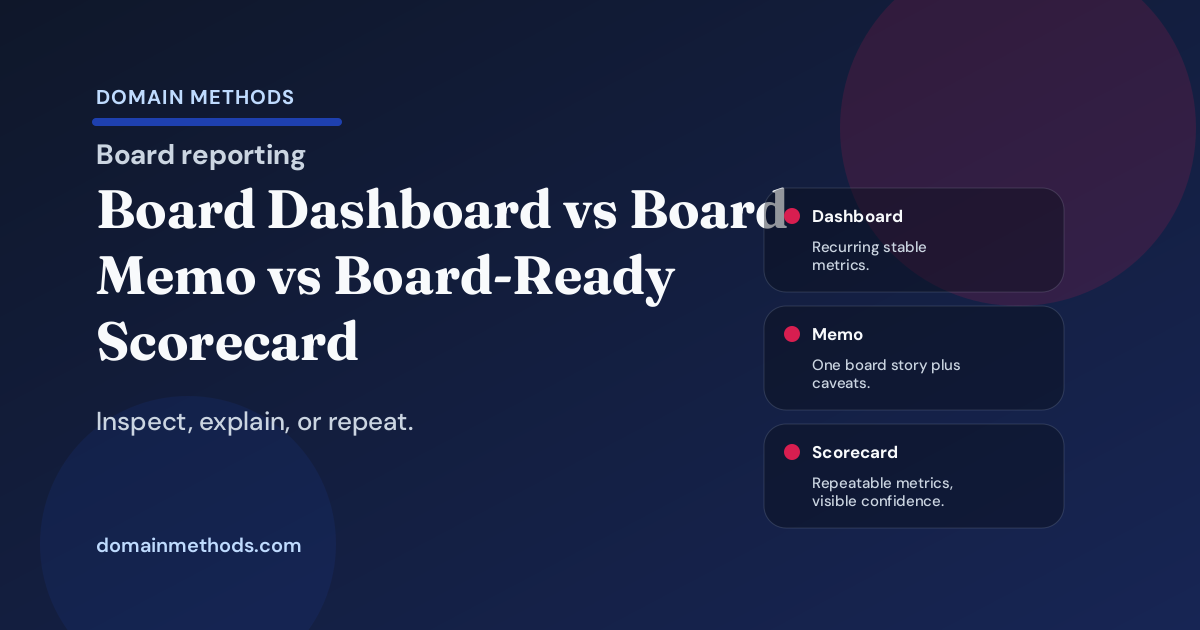
If the board needs to inspect, use the dashboard. If it needs to interpret, use the memo. If it needs to repeat the same trusted view every cycle, use the scorecard.
Worked examples from real board-pressure patterns
Pattern 1: the room keeps asking for one better chart
If the board keeps asking for one better chart but the real issue is that the same few metrics need a cleaner recurring shell, a scorecard usually beats a dashboard.
Why? Because the ask sounds like exploration, but the operating need is repeatability.
Pattern 2: the number moved and leadership no longer trusts the story
If a board-safe number changed meaning, fell in confidence, or now needs caveat-heavy explanation, a memo usually beats both a dashboard and a scorecard.
Why? Because the board needs interpretation, not a cleaner container.
Pattern 3: executives want the metrics available before and between meetings
If the metrics are already stable and the board wants a controlled reference view outside the live meeting, a narrow board dashboard can work well.
Why? Because the job is recurring inspection, not one-off persuasion.
Pattern 4: every prep cycle turns into a definition argument
If prep still depends on reconciling pipeline, CAC, or revenue logic in the final 48 hours, none of the three formats is the real answer yet.
Why? Because the artifact choice is being asked to absorb reporting debt it cannot fix.
The practical mistake to avoid
Do not choose the format that flatters the problem.
Choose the format that exposes the problem honestly enough for the board to make the right call.
A dashboard flatters teams that want to look systematic. A memo flatters teams that want to look strategic. A scorecard flatters teams that want to look disciplined.
Those instincts are understandable.
They just become expensive when the artifact choice is compensating for unresolved confidence, definition, or ownership gaps.
If the team has earned repeatability, ship the scorecard. If the board needs a sharper story, ship the memo. If leadership needs stable recurring inspection, ship the narrow dashboard.
If the debate still feels impossible, do not solve that with design polish.
Solve it by naming the board decision, the confidence bar, and the reporting model that has to hold once the meeting is over.
Download the Board Report Format Chooser Worksheet
Use this worksheet to decide whether the next board-reporting artifact should be a dashboard, a memo, a scorecard, or a stop-and-scope reset before the next executive review.
Instant download. No email required.
Want future posts like this in your inbox?
This form signs you up for the newsletter. It does not unlock the download above.
Download the Board Report Format Chooser Worksheet (PDF)
A practical worksheet for choosing between a dashboard, board memo, or board-ready scorecard based on confidence level, executive use, upkeep burden, and failure mode.
DownloadIf the board question keeps exposing cross-team metric conflict
Three Teams, Three Numbers
Use the diagnostic when marketing, finance, and RevOps still walk into board prep with different versions of revenue, pipeline, efficiency, or confidence.
See the metric-alignment diagnosticIf the artifact debate is really a fuzzy request problem
Translate the Ask
Use the sprint when leadership keeps asking for a board dashboard, a deck refresh, and a cleaner number all at once without defining the actual decision.
See the translation sprintSee It in Action
Common questions about board dashboards, board memos, and board-ready scorecards
When is a board dashboard actually the right choice?
What makes a board memo different from a normal board deck slide?
When should we use a board-ready scorecard instead of a memo?
What if none of the three formats feels safe yet?

About the author
Jason B. Hart
Founder & Principal Consultant
Helps mid-size SaaS companies turn messy marketing and revenue data into decisions leaders trust.