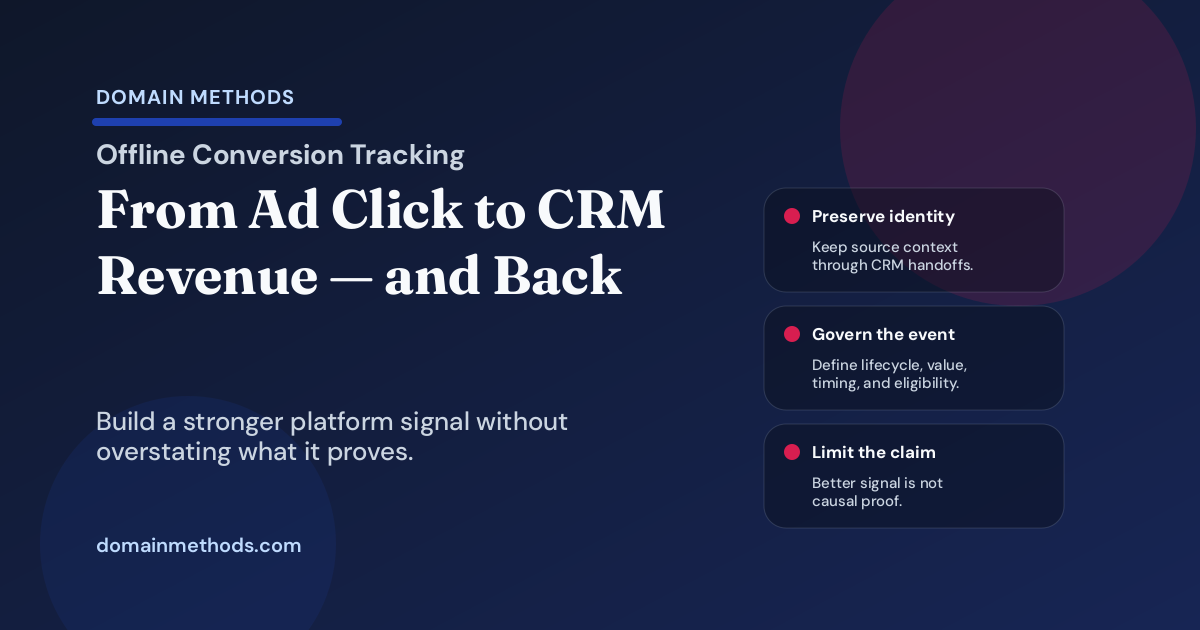
The B2B Offline Conversion Feedback Loop: From Ad Click to CRM Revenue and Back
- Jason B. Hart
- Marketing Analytics
- July 9, 2026
Table of Contents
What is B2B offline conversion tracking?
B2B offline conversion tracking is the governed process of connecting an ad interaction to a later CRM or revenue outcome, then sending an eligible event back to the ad platform for measurement or optimization.
The word offline is misleading. In SaaS, the outcome usually happened in software. It was simply outside the ad platform: a contact became a qualified lead, an account opened an opportunity, a deal reached closed-won, or finance reconciled the booking.
The useful loop looks like this:
ad interaction -> form and source capture -> CRM identity -> account and opportunity -> business outcome -> privacy rule -> platform upload -> receipt and QA -> reporting or bidding
The dangerous version skips the contracts in the middle. It sends a field called Qualified back to the platform, assumes the match proves the journey, and lets a successful upload become evidence of causality.
A stronger signal can improve measurement and optimization. It cannot rescue a bad lifecycle definition, create consent, reconcile revenue, or prove that the ad caused the deal.
Start with the First-Party Measurement Readiness Checklist if you do not yet know whether the capture layer is trustworthy. This guide owns the next layer: the CRM-to-platform feedback-loop contract.
The end-to-end feedback-loop architecture
The loop crosses systems with different jobs. The ad platform knows the interaction. The CRM knows a commercial workflow. The warehouse can preserve joins and history. Finance knows which economic definition leadership is actually using. Privacy rules decide whether a record is eligible to move at all.
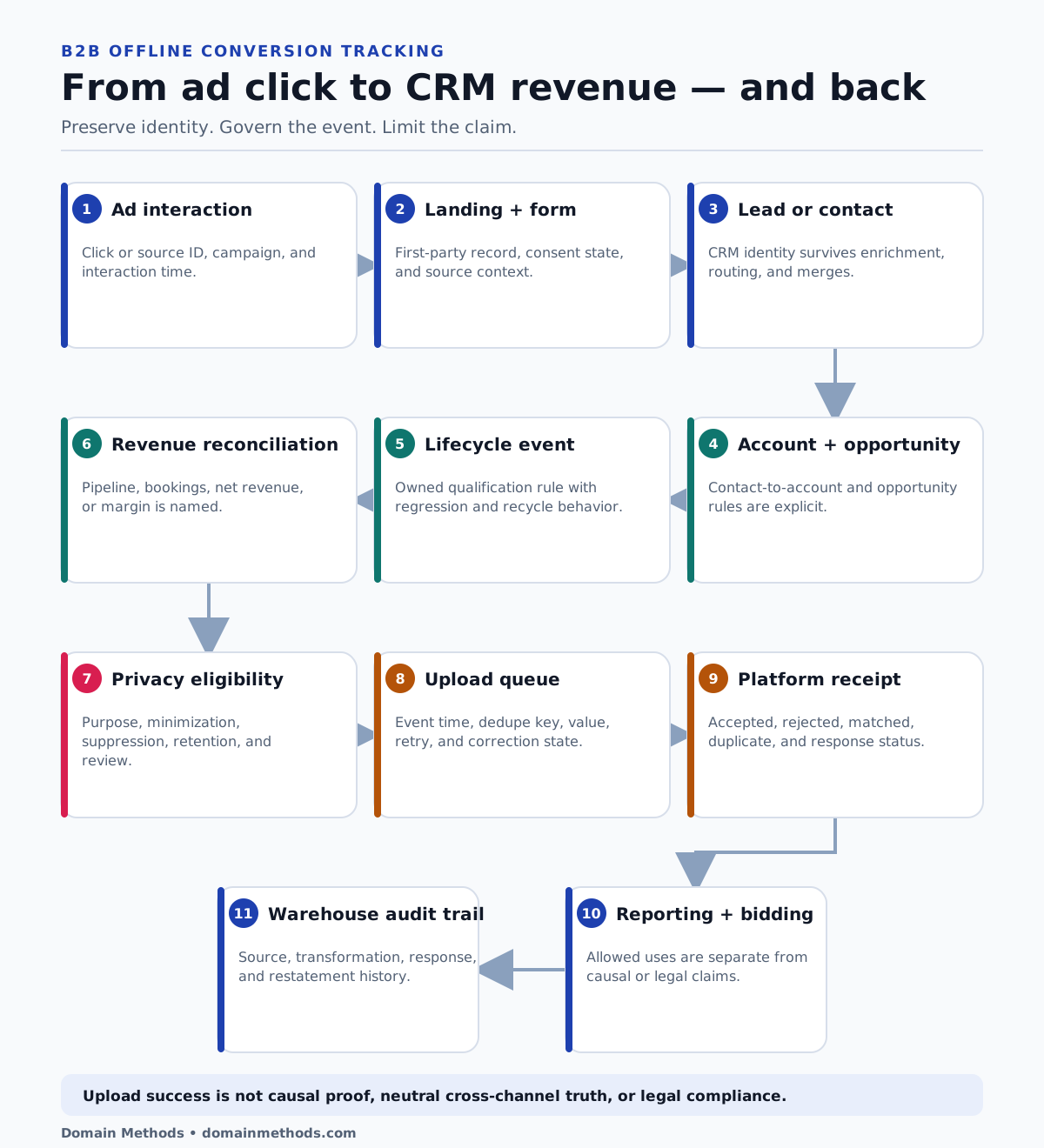
Eleven checkpoints matter:
- Ad interaction. Capture the platform click or source identifier when it is available and permitted.
- Landing page and form. Preserve campaign context, timestamp, consent state, and a first-party record key.
- Lead or contact. Create the CRM record without letting enrichment or routing overwrite the original source trail.
- Account and opportunity. Resolve the contact to the commercial entity and opportunity the business will evaluate.
- Lifecycle event. Apply an owned rule for MQL, accepted lead, SQL, qualified opportunity, or another stage.
- Revenue reconciliation. Decide whether the value means pipeline, bookings, recognized revenue, net revenue, or margin.
- Privacy and processing rule. Determine whether the event and identifiers are eligible for the intended destination and purpose.
- Upload queue or integration. Create an idempotent record with event time, value, currency, destination, and retry state.
- Platform receipt. Record accepted, rejected, matched, duplicated, or corrected status rather than treating “sent” as “done.”
- Reporting and bidding. Declare whether the event may support diagnostics, attribution, optimization, or a narrower use.
- Warehouse audit trail. Preserve the source record, transformation, upload response, correction history, and reconciliation result.
A real implementation can use native integrations, a customer data platform, a reverse-ETL tool, an API, or a batch process. The connector matters less than the contract it carries.
Choose the event before choosing the integration
The first hard decision is not Google versus LinkedIn versus Meta. It is which business event deserves to travel back.
| Candidate event | Speed | Volume | Proximity to business value | Definition stability required | Main optimization risk |
|---|---|---|---|---|---|
| Raw lead or form submit | Fast | High | Low | Low to moderate | The platform learns to find cheap form fills, including low-fit or duplicate demand. |
| Marketing-qualified lead | Fast to moderate | Medium to high | Low to medium | Moderate | A scoring or routing rule becomes the hidden objective function. |
| Sales-accepted or sales-qualified lead | Moderate | Medium | Medium | High | Rep behavior, capacity, and acceptance discipline distort the signal. |
| Qualified opportunity | Slow | Low to medium | High | High | Sparse feedback and inconsistent opportunity creation make the event unstable. |
| Closed-won or bookings | Very slow | Low | Very high | Very high | The platform receives too little signal too late; sales execution gets credited to media. |
| Recognized or net revenue | Very slow | Low | Highest for finance use | Very high | Accounting timing and adjustments arrive after the optimization window. |
| Expansion or renewal | Long-cycle | Low | High for lifecycle economics | Very high | The original acquisition event and later account experience get collapsed into one credit story. |
A fast, high-volume event can train the platform toward the wrong business behavior. A slow, high-value event can arrive too late or too sparsely to help.
Consider a 90-day SaaS sales cycle. The growth team generates 800 demo requests in a month. Sales accepts 260. Eighty become qualified opportunities. Twelve close. If the platform optimizes to the raw form, it gets speed and volume but may chase weak accounts. If it waits for closed-won, it gets stronger economic meaning after campaigns, territories, pricing, and sales behavior have all changed.
A practical compromise may use two events with different jobs: an early, tightly governed qualified event for optimization and a later revenue event for reconciliation. The team must keep those jobs visible. The early event is not revenue, and the revenue upload is not causal proof.
The identity and source contract
The identity contract answers one question: how does this business record retain enough lawful, accurate context to connect back to the marketing interaction?
Document at least:
- platform click identifiers where available
- UTMs and the governed campaign taxonomy
- a first-party lead or contact ID
- account and opportunity IDs
- original-source and latest-source rules
- contact merges and account deduplication
- event-time, CRM-write-time, and upload-time semantics
- which identifiers may leave the client’s environment
- the fallback when deterministic matching is unavailable or inappropriate
The Campaign Taxonomy and UTM Governance Checklist covers the source contract upstream. UTMs are useful context, but they are not a substitute for a stable record key. Click IDs can improve a platform match, but they do not explain a buying committee or neutralize every cross-device and cross-channel gap.
One operator-level failure is easy to miss: the click ID survives on the lead, then disappears when the lead converts to a contact. The opportunity is created from the account three weeks later. The upload process reads the opportunity and finds no usable source key, so the team blames the ad platform for a match-rate problem created by its own CRM handoff.
Another failure looks cleaner. The integration finds an email address, hashes it, and sends it. The match succeeds. That still does not prove the contact was eligible for that transmission, that the right opportunity was selected, or that the platform deserves full credit.
The CRM lifecycle and opportunity contract
A field name is not a definition. Before uploading a stage event, write the rule that creates it and the exceptions that can reverse it.
The contract should cover:
- stage entry and exit criteria
- who can change the stage
- stage regression, recycling, and requalification
- duplicate contacts and merged accounts
- one contact connected to several opportunities
- several contacts connected to one opportunity
- partner-sourced, sales-created, and imported opportunities
- reopened deals, renewals, and expansion
- amount changes after the initial upload
- cancellation, refund, churn, or disqualification
The difficult cases are not edge cases in a mid-size SaaS CRM. A buyer can download content from a paid campaign, enter through a partner later, join an account already in pipeline, and influence an expansion opportunity months after the original click. The upload rule needs a declared answer even when that answer is “do not send this record.”
This is why Your Attribution Problem Probably Is Not an Attribution Problem starts with workflow survival. If the source or lifecycle context disappears between contact, account, and opportunity, changing the attribution model is downstream theater.
Timing, retries, and corrections are part of the metric
A conversion event has several clocks:
- event time: when the business outcome happened
- record time: when the CRM or warehouse stored it
- upload time: when the destination received it
- decision time: when reporting or bidding used it
Those times can differ by hours, days, or months. Define the acceptable latency for the decision rather than copying a universal threshold from a vendor page.
The operating design should include:
- the platform’s current conversion window and event requirements
- retry behavior for transient failures
- an idempotency or dedupe key
- a dead-letter or error queue
- monitoring for missing and delayed batches
- correction rules for stage, value, currency, or identity changes
- a policy for events that become ineligible after the original transmission
- a pause condition when rejection, duplicate, or reconciliation rates move outside the team’s agreed range
Vendor limits change. Link to current documentation in the implementation runbook instead of freezing every field constraint into evergreen governance prose.
A common lived-in problem is value restatement. An opportunity is uploaded at $180,000 when it closes, then the contract is amended to $145,000. If the platform, CRM, warehouse, and finance layer each keep a different value, the loop has increased signal volume while reducing trust.
Privacy, consent, and governance are design inputs
Server-to-server delivery is not a consent bypass. Hashing an identifier does not automatically make it anonymous. First-party data is not automatically unrestricted data.
The permitted collection, transformation, and transmission depend on the client’s jurisdiction, notices, consent or other lawful basis, contracts, platform terms, and privacy review. This article is an operating and data-architecture guide, not legal advice.
Put the following into the design rather than a launch-day footnote:
- data minimization: send only the fields required for the declared purpose
- purpose limitation: do not quietly reuse a measurement feed for an unrelated audience or workflow
- eligibility and suppression rules
- role-based access to raw identifiers and upload logs
- retention periods for source, queue, and response data
- deletion and correction paths
- vendor and platform terms
- an owner who can pause the feed when the purpose, consent state, or data contract changes
The UK Information Commissioner’s Office is explicit that pseudonymised personal data remains in scope of data protection law. That is the right mental model for hashed matching data: risk can be reduced without pretending the person has disappeared.
What the upload can improve — and what it cannot prove
A governed offline conversion feed can improve:
- the connection between a marketing interaction and a downstream CRM outcome
- platform optimization toward a higher-quality event, where the platform supports it
- campaign and source diagnostics
- observed-path attribution
- QA of source, stage, and revenue handoffs
It does not prove:
- causal lift
- complete buyer-journey visibility
- neutral cross-channel contribution
- that the CRM stage or revenue definition is correct
- that matching is deterministic or complete
- legal compliance
Use the Marketing Measurement Confidence Stack to label what the feed produced before the number moves into a budget packet or automated decision. Use the Attribution vs MMM vs Incrementality guide when the decision has moved beyond observed-path learning. Attribution assigns credit. MMM estimates portfolio relationships. Incrementality asks what changed because of a treatment. An offline upload can feed those conversations; it cannot collapse them into one answer.
Meta’s Conversion Lift documentation, for example, describes a test/control design for incremental effect. That is a different evidence class from sending CRM events through the Conversions API and observing matched outcomes. Google and LinkedIn similarly describe how their own systems receive or use conversion signals. Those product documents explain platform behavior, not neutral portfolio truth.
The QA and reconciliation table
Set thresholds from business volume and decision impact. A team uploading twelve closed-won events per quarter needs a different operating tolerance than a team sending thousands of qualified leads per week.
| QA check | What to compare | Owner question | Failure response |
|---|---|---|---|
| Capture rate | Eligible source interactions versus records with required IDs/context | Are IDs lost before CRM or filtered intentionally? | Repair capture or document the missing population. |
| Match rate | Sent events versus platform-matched events | Is the change caused by identity, eligibility, timing, or platform behavior? | Investigate the contract; do not invent a universal target. |
| Duplicate rate | Unique business events versus accepted events | Can retries, merges, or stage re-entry create a second conversion? | Fix idempotency and restate affected periods. |
| Latency | Event time to accepted upload time | Is the signal still useful for its declared decision? | Shorten the path or downgrade the allowed use. |
| Stage reconciliation | CRM stage events versus uploaded stage events | Did regressions, recycling, or owner changes alter the total? | Reconcile by event history, not current-state snapshots. |
| Value reconciliation | Uploaded value versus CRM, warehouse, and finance value | Which economic definition is authoritative? | Correct, restate, or label the feed directional. |
| Accepted and rejected events | Queue sends versus platform responses | Are failures visible by reason and destination? | Retry only eligible transient failures; route the rest to review. |
| Consent/eligibility suppression | Potential records versus permitted records | Is the exclusion rule current and auditable? | Pause on policy drift or unexplained eligibility changes. |
| Error queue | Failed, delayed, and manually corrected records | Who owns the oldest unresolved item? | Set an age-based escalation and pause condition. |
| Reporting/bidding reconciliation | Platform totals versus governed business totals | Is the platform optimizing the event the team intended? | Separate diagnostic, attribution, and bidding uses. |
The QA meeting should produce an action, not just a dashboard. Name the failed contract, owner, deadline, and whether the feed stays live.
Use the worksheet to define one loop
Do not start with every platform and every lifecycle stage. Pick one decision, one destination, and one event.
Download the B2B Offline Conversion Feedback Loop Worksheet
Define the event, identity keys, CRM mapping, privacy eligibility, timing, corrections, QA ownership, allowed uses, and claims that stay off-limits.
Instant download. No email required.
Want future posts like this in your inbox?
This form signs you up for the newsletter. It does not unlock the download above.
Bring the growth or paid-media owner, RevOps or CRM owner, analytics owner, and the person responsible for privacy review. If revenue value is in scope, include finance.
Leave the session with:
- one business decision
- one selected event and exact definition
- one identity and source contract
- one contact-account-opportunity mapping rule
- one eligibility and suppression rule
- one latency, retry, correction, and pause policy
- one QA owner
- one list of allowed uses and prohibited claims
If the feedback loop itself needs an operating layer, use SaaS Marketing Attribution. If identity, source precedence, or revenue joins fail upstream, use Data Foundation. If the immediate question is why spend, platform, CRM, and revenue stories disagree, start with Where Did the Money Go?.
The B2B SaaS attribution case study shows why this matters: the useful outcome was not another channel screenshot. It was a spend-to-revenue chain that marketing, the CRM, billing, and leadership could inspect together.
Sources checked July 9, 2026
These sources describe current platform behavior or high-level privacy concepts. They do not establish neutral cross-channel truth or certify legal compliance.
- Google Ads: About offline conversion imports — offline conversion import options and enhanced conversions for leads.
- Google Ads: About enhanced conversions — use of hashed first-party conversion data for measurement and matching.
- Google Analytics: Consent mode reference — consent parameters, tag behavior, storage, and modeling inputs.
- LinkedIn Marketing API: Conversions overview — direct server-to-server conversion connection for campaign measurement and optimization.
- LinkedIn: Privacy-first advertising playbook — LinkedIn’s privacy and first-party measurement framing.
- Meta: About Conversions API — direct server-to-server connection between business event data and Meta systems.
- Meta: About Conversion Lift — test/control framing for estimating incremental effects inside Meta’s measurement environment.
- UK ICO: Pseudonymisation guidance — pseudonymised personal data remains in scope of data protection law.
The practical takeaway
An offline conversion feed is a governed translation layer. It translates a commercial outcome into a platform signal.
That translation can help the platform learn from something closer to business value. It can also automate every unresolved argument about identity, qualification, revenue, privacy, and credit.
Choose the event before the integration. Preserve the source trail. Make the eligibility rule explicit. Reconcile the value. Monitor the queue. Write down what the upload is allowed to improve and what it is not allowed to prove.
Better signal is useful. Honest limits are what make it trustworthy.
B2B Offline Conversion Feedback Loop Worksheet
Define the event, identity keys, CRM mapping, privacy eligibility, latency, correction rules, QA owners, and claim limits for one live feedback loop.
DownloadWhen the feedback loop needs a trusted operating layer
SaaS Marketing Attribution
Build the source, lifecycle, opportunity, evidence, and reporting rules that let CRM outcomes improve marketing decisions without becoming a new black box.
See SaaS Marketing AttributionIf identity and revenue joins break upstream
Data Foundation
Repair source precedence, contact-account-opportunity mapping, warehouse joins, and revenue reconciliation before sending a weak signal back to a platform.
See Data FoundationSee It in Action
Common questions about B2B offline conversion tracking
What is offline conversion tracking in B2B SaaS?
Which CRM event should a SaaS team send back to an ad platform?
Does a successful offline conversion upload prove that a campaign caused revenue?
Does hashing customer data make the upload anonymous or automatically compliant?

About the author
Jason B. Hart
Founder & Principal Consultant
Helps mid-size SaaS companies turn messy marketing and revenue data into decisions leaders trust.