Attribution vs MMM vs Incrementality: Which Measurement Method Should Carry the Decision?
- Jason B. Hart
- Marketing Analytics
- May 12, 2026
- Updated June 18, 2026
Table of Contents
What is the difference between attribution, MMM, and incrementality?
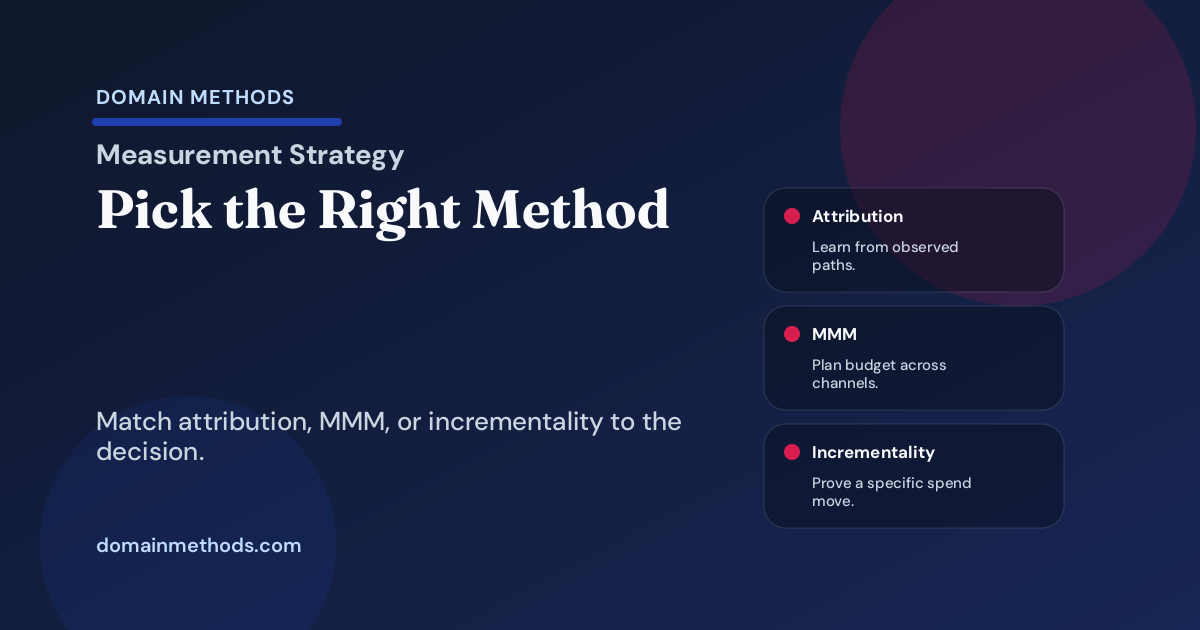
Attribution explains observed paths, MMM estimates portfolio-level contribution over time, and incrementality testing estimates whether a specific treatment caused lift.
That is the clean version. The operating version is messier: each method can be useful, and each can be dangerous when it gets asked to carry the wrong decision.
Most measurement debates go sideways because the team starts with the method. Someone wants better attribution. Finance asks about MMM. A growth lead wants a holdout. A platform dashboard says the campaign is working. None of that is wrong by itself, but it skips the practical question: what decision are we trying to make, and how much confidence does that decision require?
If the decision is weekly campaign tuning, attribution and platform reporting may be enough. If the decision is next quarter’s channel mix, attribution is probably too low-level. If the decision is whether a material budget move caused lift, MMM may be too broad and attribution may be too self-interested.
The point is not to pick a favorite method. The point is to stop letting one method pretend it can answer every marketing question.
Use this alongside the Marketing Attribution Playbook when you need the broader operating model behind the measurement decision, not just this narrower tactic.
Start with the decision, not the model
Before a team argues about attribution vs MMM vs incrementality, write down the sentence the method is supposed to support.
Examples:
- “Should we cut branded search by 30% next quarter?”
- “Is paid social prospecting creating new demand or harvesting demand we would have captured anyway?”
- “Should ecommerce spend move from Meta into YouTube or CTV?”
- “Can the board trust this pipeline-source story?”
- “Which channel family deserves more budget in the annual plan?”
- “Are we over-crediting partners, paid search, or retargeting because of how the platform sees the world?”
Those are different questions. They sit at different altitudes. They need different evidence.
This is where teams often overcomplicate the work. The first move is not usually a bigger tool. It is naming whether the decision is tactical, portfolio-level, causal, or mostly a communication problem.
A growth team optimizing next week’s paid search budget does not need a six-month MMM project before changing bids. A finance team approving a major budget reallocation should not be asked to trust a platform ROAS screenshot. A SaaS revenue leader trying to explain pipeline movement cannot rely on one campaign’s click path when CRM source logic and sales-touch rules are disputed.
This gets sharper once AI starts recommending the action. A campaign copilot, lead-scoring model, or budget assistant can move faster than the measurement system around it. Use the AI readiness scorecard to test the inputs below the workflow, then use this comparison to choose the evidence layer above it.
The comparison matrix
Use this table as the first-pass filter. It will not make the decision for you, but it will stop the common mistake of asking one method to do five jobs.
| Method | Best use case | Decision altitude | Data required | Speed / cadence | What it does well | What it overclaims if misused | Good next step when not ready |
|---|---|---|---|---|---|---|---|
| Platform reporting | Fast in-platform optimization and QA | Campaign / tactic | Platform events, conversion setup, channel-specific rules | Daily to weekly | Helps operators catch delivery, creative, audience, and conversion problems quickly | Pretends the platform’s credited revenue equals true business lift | Reconcile platform events to CRM, Shopify, warehouse, or finance outcomes before using it for budget defense |
| Multi-touch or blended attribution | Observed-path learning, source logic, campaign influence, funnel diagnostics | Journey / operating layer | Clean UTMs, campaign taxonomy, CRM stages, source precedence, touch rules | Weekly to monthly | Shows how known touches relate to pipeline, revenue, or ecommerce purchases | Pretends observed credit is the same as causality, especially across walled gardens and dark demand | Fix tagging, source rules, definitions, and stakeholder caveats before changing the model again |
| MMM / media mix modeling | Portfolio-level allocation, channel saturation, seasonality, and planning | Budget / portfolio | Spend history, trusted outcomes, seasonality, promotions, channel taxonomy, enough variation | Monthly to quarterly | Helps leaders see broad contribution and channel-mix pressure when user-level paths are incomplete | Pretends to explain individual journeys or justify every campaign decision | Build enough spend/outcome history and trusted definitions before treating model output as decision-grade |
| Incrementality / holdout / lift testing | Causal proof for a specific spend, treatment, audience, geography, or campaign | Decision / proof | Isolatable treatment, trusted outcome, sample size, clean timing, decision owner | Periodic / experiment-based | Estimates what likely happened because of the spend or treatment | Pretends one test result is permanent truth across every market, audience, and future campaign | Use attribution or MMM to choose the right question, then fix isolation or outcome trust before testing |
| Qualitative or self-reported attribution | Dark social, sales context, buyer memory, partner influence, and missing-touch clues | Signal / context | Consistent capture questions, sales notes, call context, buyer feedback | Continuous | Adds context that clickstream and models miss | Pretends anecdotes are quantifiable channel contribution | Use it as a directional input alongside source logic, not as the whole budget model |
The operator move is to let each method do the job it is good at, then document where its answer stops.
When attribution should carry the decision
Attribution belongs in the operating layer. It helps the team understand what the business can observe about touchpoints, source logic, campaign paths, and funnel movement.
It is useful when the decision is about:
- fixing broken campaign tracking
- comparing observed paths between segments
- understanding which sources show up before pipeline creation
- finding handoff problems between marketing, sales, and revenue operations
- deciding whether a campaign deserves more investigation
- giving operators a shared language for source, influence, and caveats
Attribution is especially useful for mid-size SaaS companies where CRM hygiene, sales handoffs, partner influence, and long buying committees make the revenue story hard to follow. It is not useless because it is imperfect. It is useless when the team treats it as causal proof.
A practical attribution engagement should say: “Here is what the observed path supports, here is where source logic breaks, and here is where you need a different evidence layer.” That is the argument in Attribution Didn’t Die. It Just Got Demoted.
If the real problem is messy source capture, inconsistent lifecycle stages, or CRM-to-revenue disagreement, start with attribution cleanup or the SaaS Marketing Attribution path before buying a bigger model.
When MMM should carry the decision
MMM belongs in the portfolio conversation. It is useful when leadership wants to understand how channel families, spend levels, seasonality, and broader market conditions relate to outcomes over time.
It is the better fit for questions like:
- how much budget should sit in paid search, paid social, video, partners, or offline spend?
- where might we be hitting diminishing returns?
- did the total spend mix probably drive growth, or did the platform reports overstate it?
- how should finance think about channel contribution when user-level tracking is incomplete?
- which areas deserve a narrower incrementality test next?
That last point matters. MMM does not have to be the final answer. Often it is the planning layer that identifies where the expensive uncertainty lives.
A SaaS team might use MMM to see that paid social looks weaker than the platform report suggests, then use a narrower holdout or geo read before cutting budget. An ecommerce team might use MMM to understand whether YouTube, Meta prospecting, and promotions are creating portfolio lift before asking a specific channel manager to defend platform ROAS.
The Media Mix Modeling for SaaS and Ecommerce Budget Decisions guide goes deeper on when MMM is ready and when it is premature.
The lived-in warning: MMM is not magic just because it feels more executive. If campaign taxonomy is unstable, Shopify revenue is not reconciled to net revenue, CRM opportunities are inconsistently sourced, or finance does not trust the outcome definition, the model will mostly make the mess look mathematically mature.
When incrementality should carry the decision
Incrementality belongs where the team needs to know whether a specific spend or treatment caused lift.
Use it when the decision is expensive, isolatable, and likely to change what the business does next. That could mean a holdout test, conversion lift study, geo experiment, market-level test, audience split, or another causal design that fits the channel and business model.
Good incrementality questions sound like this:
- If we cut branded search, how much demand do we actually lose?
- Is retargeting creating incremental orders or mostly taking credit for buyers who would return anyway?
- Does paid social prospecting create contribution-margin-positive demand, or just attributed revenue?
- Would YouTube or CTV lift pipeline or ecommerce revenue enough to justify the spend?
- Should we run a promotional holdout before making discounting a recurring lever?
- Does a sales-assisted lifecycle campaign actually change expansion or retention behavior?
This is why the holdout-test readiness guide starts with decision readiness, not testing theater. A holdout is not a maturity badge. It is a way to answer a specific expensive uncertainty.
For ecommerce teams, the method has to connect to margin. A test that increases attributed Shopify revenue but lowers contribution profit is not a win. ROAS can look clean while returns, discounts, fulfillment cost, and repeat-purchase effects tell a different story.
For SaaS teams, the method has to respect the sales cycle. If the outcome takes months to appear and leading indicators are not trusted, the test may be directionally useful but not ready to carry a board-level budget decision.
Where platform reporting still helps
Platform reporting is not the villain. It is fast, operational, and close to the work.
Use it for QA and tuning:
- did conversion tracking fire?
- did creative fatigue appear?
- did a campaign delivery change explain the movement?
- is the platform seeing enough signal to optimize?
- did a channel-level experiment break because eligibility or audience rules changed?
The problem starts when platform reporting becomes budget evidence without caveats. Platforms are not neutral witnesses. They have their own attribution windows, modeled conversions, identity gaps, and incentives.
A practical team still uses platform data. It just does not let platform credit settle finance questions by itself.
Where qualitative signal fits
Self-reported attribution, sales notes, customer interviews, and buyer memory can be useful when the click path is incomplete. They often catch dark social, partner influence, executive referrals, community exposure, and research behavior that never becomes a clean touchpoint.
But qualitative signal is context, not channel math.
A good use is: “We keep hearing that prospects first heard about us through a peer community, but our CRM source rules credit paid search after branded demand appears.” That is a clue. It should change the investigation.
A bad use is: “Thirty people mentioned podcasts, so podcasts drove 30% of pipeline.” That is just another attribution overclaim with softer inputs.
SaaS examples: which method belongs in the room?
| SaaS decision | Best first method | Why |
|---|---|---|
| Weekly paid search campaign tuning | Platform reporting plus attribution | The decision is tactical and fast. You still need source/campaign hygiene, but MMM is too slow and broad. |
| Quarterly channel budget planning | MMM, with attribution caveats | Leadership needs a portfolio read across channels, not a path-by-path credit report. |
| Cutting branded search by a material amount | Incrementality or holdout test | The question is causal: what would happen without that spend? |
| Explaining pipeline-source movement to the board | Attribution plus revenue-definition governance | The team needs a trusted story across CRM, sales touch rules, and finance-recognized pipeline. |
| Choosing which uncertainty to test next | MMM plus attribution diagnostics | Broad modeling can point to the pressure area; attribution diagnostics can show where the operating layer breaks. |
The tradeoff is usually speed versus confidence. Attribution can move quickly but overclaims causality. MMM can support planning but needs enough history. Incrementality can answer a narrow causal question but requires isolation, timing, and a decision owner who will act on the result.
Ecommerce examples: which method belongs in the room?
| Ecommerce decision | Best first method | Why |
|---|---|---|
| Diagnosing a Meta campaign performance drop | Platform reporting plus contribution-aware attribution | Operators need fast campaign signal, but the business still needs margin context. |
| Deciding whether to scale YouTube or CTV | MMM, then incrementality if the bet is material | The first question is portfolio contribution; the second is whether the specific spend creates lift. |
| Testing whether retargeting is over-credited | Incrementality / holdout | Retargeting often receives credit for demand that would have returned anyway. |
| Defending paid growth when Shopify revenue is up but profit is not | Attribution plus margin reconciliation | Revenue credit is not enough if discounts, returns, COGS, or fulfillment change the answer. |
| Evaluating branded search cuts | Incrementality test | Platform ROAS will almost always defend branded search; the business question is what demand disappears without it. |
This is where ecommerce measurement gets practical fast. A Northbeam-style or platform-attribution view can be useful, but the decision usually needs more context: net revenue, contribution margin, returning-customer behavior, promotion timing, and channel interaction.
If that context is missing, the next move may not be a test. It may be cleaning up the ecommerce performance model first. The true CAC guide and the Shopify margin guide are better starting points when the profit layer is the real blocker.
A simple decision rule
Use this rule before the next measurement debate:
| If the question is… | Start with… | Do not let it claim… |
|---|---|---|
| “What happened in the path we can observe?” | Attribution | True causal lift |
| “How should the whole channel mix change?” | MMM | Campaign-level truth or individual journey logic |
| “Did this spend or treatment create lift?” | Incrementality testing | Permanent truth across every future context |
| “Is the campaign technically working?” | Platform reporting | Neutral business contribution |
| “What did buyers say influenced them?” | Qualitative signal | Quantified channel contribution by itself |
The best teams do not collapse these into one dashboard. They create a measurement stack with clean job descriptions.
Attribution for observed paths.
MMM for portfolio planning.
Incrementality for causal proof.
Platform reporting for operational tuning.
Qualitative signal for missing context.
What to do when none of the methods is ready
Sometimes the answer is not “pick attribution” or “buy MMM” or “run a holdout.” Sometimes the answer is: the method is not ready to carry the decision yet.
Common blockers include:
- campaign names and UTMs do not map cleanly to channel families
- CRM source rules conflict with sales behavior
- ecommerce revenue is not reconciled to returns, discounts, or contribution margin
- spend history is too short or too inconsistent for MMM
- audience or geography cannot be isolated for a holdout
- leadership has not agreed on what action the result would trigger
- finance does not trust the outcome definition
That last one is underrated. If no one agrees what will happen when the result comes back, the measurement work becomes theater. A directional result gets overclaimed when it is favorable and dismissed when it is uncomfortable.
The cleanup work may be less glamorous than a new model. It is also what makes the model usable.
Download the Modern Measurement Decision Guide
Use the guide before the next meeting where attribution, MMM, incrementality, and platform reporting are getting mixed together.
Download the Modern Measurement Decision Guide
Sort the budget question into the right evidence lane before the team buys a tool, changes the model, or moves spend.
Instant download. No email required.
Want future posts like this in your inbox?
This form signs you up for the newsletter. It does not unlock the download above.
The worksheet helps you write down:
- the decision the method needs to support
- the evidence level required: directional, decision-grade, or board-grade
- which method is allowed to carry the decision
- where attribution, MMM, incrementality, platform reporting, or qualitative signal should stop
- which data cleanup has to happen before the next method is safe
The practical takeaway
The wrong method usually creates one of two problems.
The team either moves too slowly because every decision gets escalated into a modeling project, or it moves too confidently because a low-altitude metric is being used for a high-altitude decision.
Domain Methods helps teams separate those layers. If the immediate pain is wasted spend, inflated platform credit, or an unclear budget story, start with Where Did the Money Go?. If the attribution operating layer itself is broken, start with SaaS Marketing Attribution.
The goal is not a prettier measurement stack. It is a cleaner decision: what should we trust, what should we caveat, and what should we prove before the next budget move.
Modern Measurement Decision Guide
A lightweight worksheet for sorting marketing measurement questions into attribution, MMM, or incrementality lanes before the next budget debate.
DownloadWhen spend confidence is the real problem
Where Did the Money Go?
Use the diagnostic when platform reporting, attribution, finance, and business outcomes disagree before the next budget call.
See the spend diagnosticIf attribution still needs the operating layer
SaaS Marketing Attribution
Use the focused attribution service when the team needs cleaner source logic, channel caveats, and reporting rules before the model debate continues.
See SaaS Marketing AttributionSee It in Action
Common questions about attribution, MMM, and incrementality
Is MMM better than attribution?
When should a team use incrementality testing instead of attribution?
Can ecommerce teams use the same measurement stack as SaaS teams?
What should we do if the data is not ready for MMM or incrementality?

About the author
Jason B. Hart
Founder & Principal Consultant
Helps mid-size SaaS companies turn messy marketing and revenue data into decisions leaders trust.