The Activation Data Contract Before Reverse ETL Hits CRM
- Jason B. Hart
- Data Activation
- May 24, 2026
- Updated June 17, 2026
Table of Contents
What is an activation data contract?
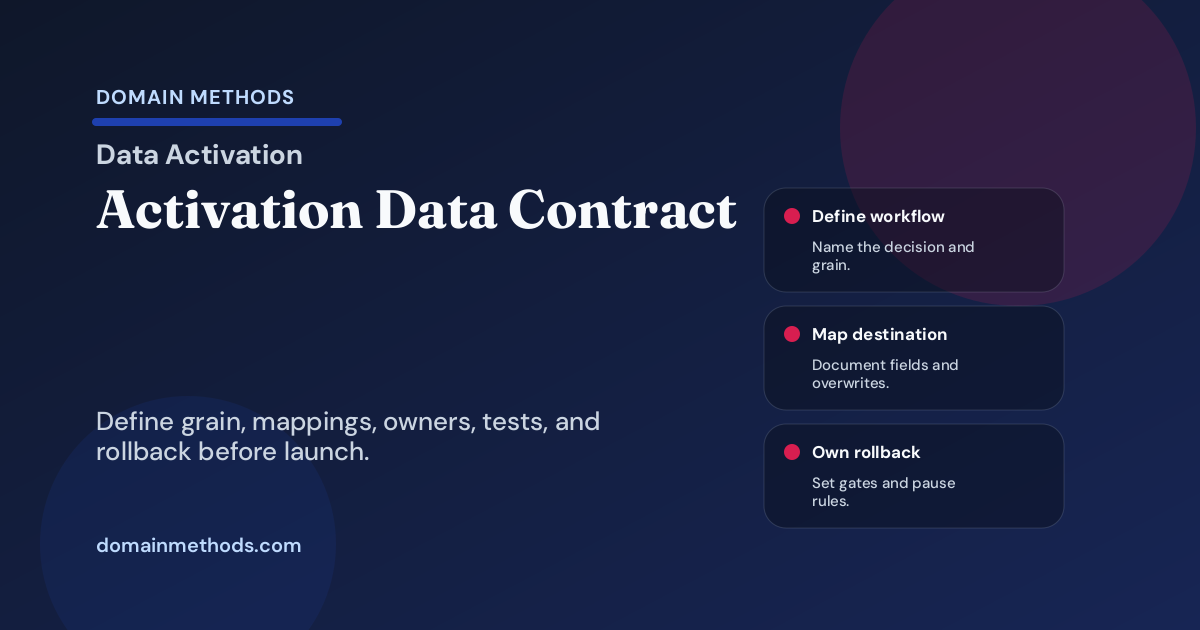
An activation data contract is the operating record that says when a warehouse model, score, audience, or field is safe to use in a live downstream workflow. It sits between the data model and the business action.
A reverse ETL job can run cleanly and still create a mess in Salesforce, HubSpot, Braze, a CS tool, or an AI-assisted workflow. The SQL can be right. The sync can be green. The problem is that nobody wrote down what the value is allowed to do once it leaves the warehouse.
That is where activation gets expensive. A churn-risk band shows up on the wrong account. A lifecycle audience includes customers with open support escalations. A score overwrites context a rep was using. A product-qualified account flag triggers follow-up before the account owner agrees with the definition. A personalization model reads a stale profile field and sounds confident anyway.
The contract is not paperwork for paperwork’s sake. It is the line between “we can move data” and “the business can trust what this data is about to change.”
If the team is still debating whether reporting is ready to become action, start with the Reporting-to-Activation Readiness Stack. If the workflow is already chosen, use this contract before the first live sync.
The short version: the contract has to answer ten questions
Use this table before a reverse ETL model writes to CRM, lifecycle, ad, success, support, or AI workflow tools.
| Contract component | What has to be explicit | Launch risk if it is missing |
|---|---|---|
| Workflow name and decision | The business action the sync is supposed to support. | The team ships a field without knowing which behavior should change. |
| Entity grain | Account, contact, user, opportunity, subscription, or another grain. | The destination applies account logic to contacts, users, or opportunities. |
| Matching rule | Stable identifiers and fallback logic. | Values land on the wrong record or fail silently. |
| Source lineage | Source systems, warehouse models, and owner. | Nobody can tell whether a bad value is a source issue, model issue, or workflow issue. |
| Destination mapping | Field, audience, score, overwrite behavior, null handling, and allowed values. | The sync erases context or triggers rules nobody reviewed. |
| Freshness expectation | Cadence, staleness threshold, and expiry rule. | A stale value drives new outreach, routing, or AI suggestions. |
| Suppression logic | Exclusions, holdouts, consent, owner rules, and human-review thresholds. | The workflow reaches records it should leave alone. |
| Quality gates | Tests, sample review, row-count limits, null-rate limits, match-rate thresholds. | The team confuses pipeline success with workflow safety. |
| Owners | Source-model owner, destination-field owner, workflow owner, business outcome owner. | Every incident becomes a cross-functional argument. |
| Monitoring and rollback | Alerts, retry rules, pause rule, communication path, and first review date. | The workflow keeps running after trust breaks. |
A useful contract should fit on one or two pages. If it takes a 40-page implementation deck to explain, the workflow is probably not ready to automate.
Activation Data Contract Template
Use this lightweight template to document grain, identifiers, field mapping, freshness, suppression, tests, owners, and rollback before a reverse ETL sync changes Salesforce, HubSpot, Braze, or AI workflows.
Instant download. No email required.
Want future posts like this in your inbox?
This form signs you up for the newsletter. It does not unlock the download above.
Start with the workflow, not the model name
The first line of the contract should not be mart_account_activation_current. It should be the decision the business is trying to improve.
For example:
| Weak contract name | Better contract name |
|---|---|
account_health_score sync | Renewal-risk field used by CSMs before account planning calls |
lifecycle_segment_current audience | Expansion-nurture eligibility for product-active customer admins |
pql_score field | Sales follow-up priority for product-qualified accounts in HubSpot |
ai_next_best_action payload | AI suggestion context for reps on open expansion opportunities |
That wording forces the right conversation. A data team may think the work is “sync the field.” The destination owner thinks the work is “do not send bad work to my team.” The buyer cares whether the workflow changes revenue, retention, speed, or trust.
If you cannot write the workflow decision in plain English, do not launch the sync yet. You are still in requirements discovery, not activation.
Define entity grain before matching rules
Entity grain is where activation contracts get practical fast. Is the value about an account, a contact, a user, an opportunity, a subscription, a workspace, or a household? The answer changes matching, ownership, testing, and downstream interpretation.
A mid-size SaaS team can have all of these in play at once:
| Entity | Common activation use | Common mistake |
|---|---|---|
| Account | Renewal risk, expansion tier, sales territory, fit score. | Writing account-level values onto contacts without showing account context. |
| Contact | Persona, role, consent, lifecycle status, engagement. | Treating a contact’s behavior as if it represents the whole account. |
| User | Product adoption, feature usage, activation milestone. | Syncing user behavior into CRM without deciding which contact should own it. |
| Opportunity | Stage, forecast, buying committee, next step. | Mixing opportunity fields with account-level health or intent. |
| Subscription | Plan, renewal date, ARR, billing status, usage entitlement. | Letting billing truth and CRM truth fight without source precedence. |
The lived-in failure mode: account matching looks boring until a strategic account has five subsidiaries, three Salesforce account records, two billing entities, and one product workspace shared by users from different domains. A “successful” match can still be the wrong operational answer.
Write the grain first. Then write the matching rule. Then make the destination owner review examples before the first sync.
Map the destination like it can trigger work, because it can
A reverse ETL destination is not a passive spreadsheet. A field in Salesforce, HubSpot, Braze, or a support workspace can feed reports, lists, routing rules, journeys, tasks, alerts, playbooks, and AI prompts.
The mapping section should answer more than “which column maps to which field?”
| Mapping question | Why it matters |
|---|---|
| Is the sync creating, updating, or overwriting the value? | Overwrites can erase manual context or override destination-owned logic. |
| What happens when the source value is null? | Nulls can remove a value, preserve the old value, or create false confidence. |
| What are the allowed values? | A new status can break destination rules even when the warehouse accepts it. |
| Who can manually edit the destination field? | Manual override rules need a precedence decision, not a hidden tug-of-war. |
| Which automation reads this field? | One field can drive routing, nurture, alerts, reports, and AI suggestions. |
| Is there an expiry date or freshness indicator? | Users need to know whether the value still deserves trust. |
This is where Data Activation becomes more than moving rows. The implementation has to respect the destination workflow, not just the warehouse model.
A practical rule: if a human in the destination system would need context before acting on the value, the synced field should carry that context or link to it. A score without reason codes is often just a faster way to create mistrust.
Example 1: churn-risk score to Salesforce
Here is what a contract might look like for a churn-risk score used by customer success.
| Contract field | Example |
|---|---|
| Workflow decision | CSMs prioritize renewal-risk review before weekly account planning. |
| Entity grain | Account. One active customer account record per billing customer. |
| Source lineage | Product usage, support severity, billing status, renewal date, account owner, prior expansion history. |
| Destination | Salesforce account fields: churn_risk_band, risk_reason_code, risk_last_refreshed_at. |
| Matching rule | Billing customer ID to CRM account ID; no fuzzy domain fallback for high-risk updates. |
| Freshness | Refresh daily; expire visible alert after seven days without a successful refresh. |
| Suppression | Exclude churned customers, pending cancellations already owned by CS leadership, test accounts, and accounts with unresolved identity conflicts. |
| Quality gates | Account match rate above 98%, null reason code below 2%, sampled high-risk accounts reviewed by CS Ops. |
| Owners | Analytics engineering owns model; CS Ops owns field meaning; Salesforce admin owns destination behavior; CS director owns playbook. |
| Rollback | Stop overwrites, keep previous visible value, notify CS Ops and analytics engineering, review sample failures before restarting. |
The contract keeps the workflow honest. It says the score is not just a data product. It is a promise to a CSM that the account field is current enough, explainable enough, and owned enough to affect their week.
If those conditions are not true, the safer move may be a dashboard review or manual CSV review before Salesforce automation. That is not failure. That is not pretending a workflow is ready before it is.
Example 2: lifecycle audience sync to HubSpot or Braze
Audience syncs have a different risk profile. The workflow is not one rep looking at one field. It is a message or journey touching many people at once.
A lifecycle contract should make exclusions first-class, not an afterthought.
| Contract field | Example |
|---|---|
| Workflow decision | Product-active admins enter an expansion-education journey after repeated usage of a premium feature. |
| Entity grain | Contact tied to an active customer account and product user. |
| Source lineage | Product event table, user-to-contact identity map, subscription plan, lifecycle stage, account owner. |
| Destination | HubSpot static list or Braze audience used by lifecycle campaign. |
| Matching rule | Product user ID -> CRM contact ID; exclude ambiguous matches and role-based email addresses. |
| Freshness | Recompute before each send; remove contacts if qualifying behavior is older than 14 days. |
| Suppression | Unsubscribed contacts, open support escalations, active renewal negotiations, sales-owned strategic accounts, legal/compliance exclusions, holdout group. |
| Quality gates | Included/excluded sample review, send-count delta check, suppression count review, destination owner signoff. |
| Owners | Lifecycle marketing owns message; analytics engineering owns source model; RevOps owns CRM identity; CS Ops owns support/renewal exclusions. |
| Rollback | Pause campaign, freeze audience update, export included contacts, classify incident by identity, freshness, suppression, or destination logic. |
The operator detail that matters: a lifecycle marketer may ask for “all product-active admins.” That sounds simple until you ask whether current customers in renewal negotiation should get the same message, whether support escalations suppress the journey, and whether the product user is actually the CRM contact who should receive it.
Those are business rules. They deserve a contract before they become automation.
What belongs in dbt, the activation platform, and the destination tool
A good activation contract does not dump every rule into one layer. It names where each rule should live and why.
| Layer | Best ownership | Good fit | Bad fit |
|---|---|---|---|
| dbt / warehouse model | Data / analytics engineering | Business definitions, entity grain, joins, tests, lineage, durable scores and segments. | Destination-specific write behavior, manual override rules, or CRM UI context. |
| Activation platform / reverse ETL | Data activation owner with data + RevOps review | Sync cadence, field mapping, match keys, write mode, row-count monitors, retry behavior. | Deciding the business meaning of fields after source definitions are still contested. |
| Destination tool | RevOps, lifecycle, CS Ops, sales ops, support ops | Field visibility, manual edits, routing rules, journey behavior, alerts, playbook context. | Recreating warehouse definitions differently in every tool. |
| Workflow owner | Business function accountable for action | Launch approval, suppression rules, user training, first review, pause/restart decisions. | Delegating the whole operating risk to the data team because the sync is technical. |
The most common architecture mistake is putting business truth wherever the tool makes it easiest. A lifecycle exclusion lives in Braze, a similar rule lives in Salesforce, a related definition lives in dbt, and six months later nobody can explain why counts do not match.
Use the contract to keep durable definitions close to the trusted source, destination behavior close to the destination owner, and launch decisions close to the person accountable for the workflow.
If the team still cannot decide which system owns the definition, that is a Data Foundation problem before it is an activation problem.
Quality gates should block launch, not decorate the doc
The contract only works if the quality gates can stop the sync.
Use a small set of launch gates that someone can actually review:
| Gate | Example pass rule | Who signs off |
|---|---|---|
| Entity grain | 20 sampled records match the intended account/contact/user/opportunity grain. | Data + destination owner |
| Match rate | High-risk destination writes meet the agreed match threshold. | Data + RevOps |
| Null handling | Nulls preserve, clear, or flag destination values exactly as intended. | Destination admin |
| Suppression | Included and excluded samples both make sense to the workflow owner. | Workflow owner |
| Freshness | The field or audience refreshes inside the decision window. | Workflow owner |
| Alerting | Failure signals name the owner and pause rule. | Data activation owner |
| First review | A post-launch sample review is scheduled before go-live. | Workflow owner |
Do not over-engineer this. The point is not to create a compliance office for every sync. The point is to make the risky assumptions visible before they reach customers, reps, CSMs, or AI prompts.
A useful phrase in the launch review is: “What would have to be wrong for this workflow to embarrass us?” Then write the gate that catches that failure early.
When the contract reveals foundation work has to happen first
Sometimes the activation contract fails for the right reason. It shows that the team is not blocked by reverse ETL. It is blocked by trust.
Pause activation when the contract exposes any of these:
| Contract failure | What it usually means | Better next move |
|---|---|---|
| No stable account/contact/user matching rule | Identity is not ready for workflow automation. | Fix source precedence and matching inside Data Foundation. |
| Destination fields have no owner | CRM or lifecycle governance is too weak for overwrites. | Name field ownership before writing values. |
| Source models lack tests or lineage | The warehouse value may be useful, but it is not launch-safe. | Add tests and ownership before activation. |
| Suppression rules are scattered across tools | The business cannot explain who should not be touched. | Consolidate exclusion logic before scaling audiences. |
| The workflow owner cannot define a pause rule | The team wants automation without operational accountability. | Keep the workflow manual or alert-only until ownership exists. |
| AI use case lacks reason codes or review thresholds | The profile may be rich, but not safe enough for suggestion or action. | Use an AI-Ready Data Diagnostic before pushing AI into the workflow. |
The commercial lesson is straightforward: do not buy your way around unclear definitions. A better activation platform will move the wrong field faster. A CRM-native feature will still reflect the same ownership gap. A Customer 360 story will still fail if the workflow cannot survive real exceptions.
How this connects to reverse ETL tool selection
The contract also sharpens tool decisions. If the team is choosing between a reverse ETL platform, a CDP, Salesforce-native activation, or warehouse-native workflows, the contract tells you what the system must support. If that architecture choice is still open, use the CDP vs reverse ETL vs warehouse-native activation guide before treating the contract as a tool-selection shortcut.
For example:
- If multiple destinations need the same trusted fields, scores, and audiences, the warehouse and activation layer usually need stronger ownership.
- If Salesforce is the main operating surface and the logic is tightly CRM-native, the CRM operating model matters as much as the activation pipe.
- If the workflow needs cross-channel lifecycle orchestration, the destination journey tool and suppression model matter more than the sync itself.
- If dbt models already define the logic, evaluate how well the activation tool preserves that logic instead of recreating it elsewhere.
- If AI suggestions will use the profile, evaluate whether reason codes, freshness, consent, and human review travel with the signal.
That is why the contract pairs well with the dbt and reverse ETL guide, the reverse ETL tool comparison, and the data activation tool guide for dbt teams. Tool choice gets easier when the team can describe the workflow contract first.
A simple launch review agenda
Run this as a 30-minute review before the sync becomes live behavior.
| Minute | Question | Owner |
|---|---|---|
| 0-5 | What workflow decision is this sync allowed to change? | Workflow owner |
| 5-10 | What entity grain and matching rule are we trusting? | Data + RevOps |
| 10-15 | What fields, audiences, or prompts will read the value? | Destination owner |
| 15-20 | Which records must be suppressed or reviewed manually? | Workflow owner |
| 20-25 | What test, monitor, or sample review can block launch? | Data activation owner |
| 25-30 | What pauses the workflow, and who restarts it? | Workflow owner |
End the meeting with one of three decisions:
| Decision | Meaning |
|---|---|
| Launch | The contract is complete enough, gates pass, and owners accept the workflow risk. |
| Launch with caveats | The workflow can run in a limited, alert-only, or low-risk mode while the team watches examples. |
| Pause | The contract exposed identity, definition, ownership, suppression, or rollback gaps that need repair first. |
That decision is more valuable than another generic implementation checklist. It tells leaders whether the business is ready to operationalize the data or still needs to earn the right to automate.
The contract is how activation stays trusted
Reverse ETL is not the end of the data journey. It is the moment data starts changing work.
That is why the bar has to be higher than “the model runs” or “the sync succeeded.” The real question is whether the people downstream can trust the field, audience, score, alert, or AI suggestion enough to change their behavior.
A strong activation data contract gives them that trust. It names the decision, the grain, the mapping, the exclusions, the tests, and the owner. It also gives the team permission to pause when the foundation is not ready.
If your team has a valuable workflow but needs the implementation, QA, and handoff discipline to make it safe, start with Data Activation. If the contract keeps failing because identity, definitions, source precedence, or warehouse trust are still contested, fix the Data Foundation first.
Download the Activation Data Contract Template (PDF)
A lightweight template for documenting workflow purpose, entity grain, matching, mappings, freshness, suppression, tests, ownership, monitoring, and rollback before reverse ETL launch.
DownloadReady to activate trusted data?
Data Activation
Use the activation sprint when the team has a valuable workflow and needs governed implementation, QA, ownership, and handoff before live systems change behavior.
See Data ActivationInputs still contested?
Data Foundation
Start with foundation work when source precedence, identity, dbt tests, CRM hygiene, or warehouse trust has to be repaired before activation can be safe.
See Data FoundationSee It in Action
Common questions about activation data contracts
What is an activation data contract?
Is this the same as a dbt contract?
Who should own the activation contract?
When should a team pause reverse ETL launch?
Where should a SaaS team start if the contract fails?

About the author
Jason B. Hart
Founder & Principal Consultant
Helps mid-size SaaS companies turn messy marketing and revenue data into decisions leaders trust.