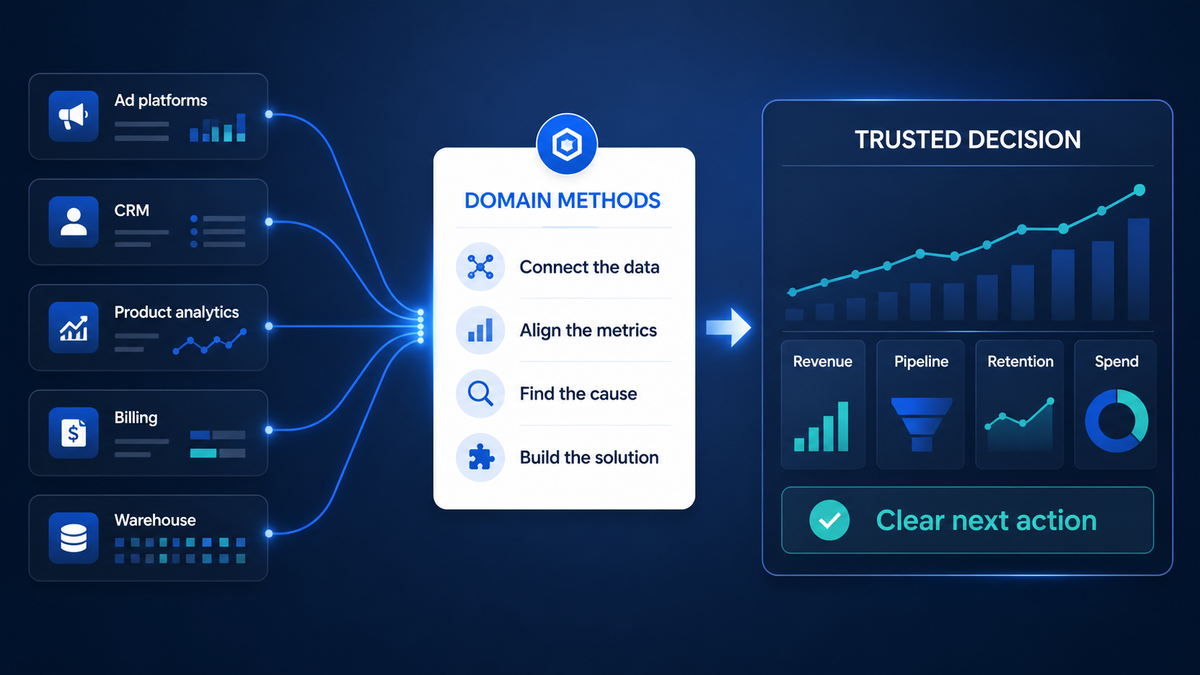
Data and analytics consulting for SaaS

Turn messy marketing, revenue, product, and operational data into decisions leaders can trust and act on.

Conflicting metrics, uncertain attribution, broken pipelines, weak governance, and warehouse data that never reaches the work all slow the same thing: a confident decision. We find the real break, then fix the smallest practical piece in a way your team can own.

  • Attribution and revenue reporting leaders can defend
  • Trusted warehouses, pipelines, and metric definitions
  • Data activation tied to measurable business outcomes

For marketing, revenue, product, and data leaders at mid-size SaaS companies, with a sweet spot of $25M–$100M ARR.

Domain Methods — Turn messy marketing, revenue, product, and operational data into decisions leaders can trust and act on.

Start with the decision that is stuck

Defend what is actually driving revenue

Marketing and growth teams should not have to guess which channels, campaigns, or customer journeys are creating revenue. We connect the evidence so leaders can make and defend the next spend decision.

  • Attribution across channels and customer journeys
  • Revenue reporting and CAC clarity
  • Holdout tests and lift measurement
  • Spend decisions leaders can defend
See revenue analytics

Fix the foundation behind the reporting

Reporting is only as reliable as the systems beneath it. We make the architecture, transformations, ownership, and definitions clear enough that the team can trust and maintain the result.

  • Warehouse and analytics architecture
  • Reliable pipelines and dbt transformations
  • Source precedence, lineage, and ownership
  • Governed metric definitions
See data foundation

Put useful warehouse data into the workflow

Useful data should reach the people and systems that can act on it. We move the right signals into the workflow with clear ownership, limits, and a way to measure whether operations improve.

  • Reverse ETL and warehouse activation
  • Predictive scoring with explicit caveats
  • Workflow ownership and exception handling
  • Measurable operational outcomes
See data activation

Keep live work healthy with an optional owner

If the work is live but your team needs an operating partner, Run + Measure can keep it healthy month to month. It is optional support after the build, not the default engagement.

  • Metric and model health checks
  • Experiment and lift readouts
  • Workflow adoption and exception reviews
  • Cancel-anytime operating support
See Run + Measure

Not sure whether the break is attribution, definitions, a pipeline, or the workflow itself? Start with a focused diagnostic.

See the diagnostic options

Start with the problem, not the service catalog

Recognize the problem first. From there, we can diagnose the break, make the smallest durable build, and add Run + Measure only if the live work needs an owner.

Marketing & Growth

Where Did the Money Go?

You are spending aggressively on paid channels and still cannot defend which half of the budget is working.

See the spend diagnostic

Revenue & RevOps

Three Teams, Three Numbers

Marketing, sales, and finance are reporting different versions of revenue, and nobody trusts the board deck.

Align the numbers

Product & Growth

The $500K Question

A product or growth bet carries real cost, but the evidence is not strong enough to build, scale, or stop with confidence.

Test the decision

Data & Analytics

Translate the Ask

A stakeholder has a broad business question, and the data team needs a clear decision, scope, and definition of done.

Translate the request

Analytics Leadership

Fractional Analytics Consultant

You need senior analytics judgment, priorities, and operating guidance without hiring a full-time leader or a large consulting team.

See fractional support

Ecommerce

Show Me the Margin

Revenue looks healthy, but ad spend, discounts, fulfillment, and returns make channel and customer profitability hard to see.

Find the real margin

AI & Data Leadership

AI-Ready Data Diagnostic

You are planning copilots, agents, or automation and need to check the underlying data, definitions, and workflow ownership first.

Check AI readiness

Operator tools

Need something useful before the first call?

Start with a worksheet your team can use in the next budget, measurement, or data decision. The tools are grouped by the question leaders need to answer, not by generic content type.

Spend and attribution confidence

Benchmarks and checklists for deciding whether channel spend, CAC, and attribution reporting are safe enough to act on.

Use the spend tools

Revenue definitions and metric governance

Scorecards and rollout trackers for making revenue, pipeline, retention, or board metrics mean the same thing across functions.

Use the metric tools

AI readiness and CRM hygiene

Worksheets for checking whether CRM data, workflow ownership, and exception handling are trustworthy enough for automation.

Use the AI readiness tools

Built on tools you already know

dbt
BigQuery
Databricks
Fivetran
dlt
Airbyte
AWS
GCP
Jason B. Hart

Most senior leaders I talk to have the same problem: they do not know who to trust and what to do next with the budget they already have. I help mid-size SaaS companies cut through that uncertainty, sort out what is actually broken, and turn messy marketing and revenue data into decisions leadership can use.

Read Jason's perspective

Jason B. Hart Founder & Principal Consultant

Trusted by data-driven teams

Representative client outcomes from teams that needed clearer numbers, faster decisions, and less dashboard theater.

We name these by role because many clients do not want homepage attribution. The tradeoff is transparency over polish: each card includes operating context, engagement scope, and a proof path to the closest published case study.

60% → 95% attribution coverage

Anonymized client outcome

B2B SaaS + Attribution Rebuild = One Number Marketing and Finance Both Trust

We were spending six figures a month on ads with no way to tell which channels were actually driving pipeline. Domain Methods rebuilt our attribution model from the ground up — unified data from ad platforms, CRM, and billing into one trusted pipeline. We went from defending numbers in every board meeting to making budget allocation decisions in hours.
VP of Growth 300-person B2B SaaS company with a seven-figure paid media budget Attribution rebuild across ad platforms, CRM, and billing
VOG

VP of Growth

300-person B2B SaaS company with a seven-figure paid media budget

99%+ pipeline uptime

Anonymized client outcome

Mid-Market SaaS + dbt Foundation = Pipeline Reliability Nobody Has to Think About

Most consultants could write SQL but couldn’t explain why it mattered to the business. Domain Methods built a dbt foundation with real governance — tested models, clear documentation, and automated quality checks. Our team went from constant firefighting to barely thinking about pipeline reliability.
Head of Data 200-person mid-market SaaS team with a brittle dbt stack dbt foundation, testing, and warehouse governance reset
HOD

Head of Data

200-person mid-market SaaS team with a brittle dbt stack

5 dashboards → 1 source of truth

Anonymized client outcome

B2B SaaS + Flexible Data Model = CRO and CFO Looking at the Same Metrics

We had five dashboards showing five different revenue numbers. Domain Methods didn’t just pick one — they built a flexible data model that adapts as our business changes. For the first time, our CRO and CFO look at the same metrics. That alignment alone was worth the engagement.
VP of Revenue Operations Workforce management platform with sales, finance, and RevOps all reporting different revenue numbers Revenue model redesign and cross-functional metric alignment
VOR

VP of Revenue Operations

Workforce management platform with sales, finance, and RevOps all reporting different revenue numbers

18% churn reduction in 3 weeks

Anonymized client outcome

PLG SaaS + Reverse ETL MVP = Churn Reduction in Three Weeks

I didn’t want a six-month roadmap — I wanted to prove that our warehouse data could reduce churn this quarter. Domain Methods shipped a reverse ETL workflow in three weeks that synced churn-risk scores to our CRM and triggered automated outreach. It moved the needle immediately. That MVP approach is exactly what PLG teams need.
Head of Product PLG SaaS business with 15,000 active accounts and churn pressure on expansion revenue Reverse ETL MVP for churn-risk scoring and CRM activation
HOP

Head of Product

PLG SaaS business with 15,000 active accounts and churn pressure on expansion revenue

2-week AI readiness roadmap

Anonymized client outcome

SaaS Data Team + AI-Ready Data Diagnostic = Clarity Before Buying Another AI Tool

Leadership wanted AI use cases fast, but our definitions, source quality, and documentation were not ready. Domain Methods audited the stack, showed us exactly what to fix first, and gave us a practical roadmap. Instead of forcing AI onto messy data, we cleaned up the foundation and moved with confidence.
VP of Data Healthcare analytics company under pressure to show AI value without breaking reporting trust AI-Ready Data Diagnostic and two-week foundation roadmap
VOD

VP of Data

Healthcare analytics company under pressure to show AI value without breaking reporting trust

Proof for the situations we talk about

A few representative examples of what happens when messy marketing and revenue data gets connected to decisions leaders can actually act on.

Growth / Attribution

From conflicting dashboards to one trusted attribution pipeline

A growth team at a 300-person SaaS company stopped arguing with finance and started making budget decisions in hours.

We unified ad platforms, CRM, and billing data into one attribution pipeline the growth team and finance team could both trust.

Read case study

Product-Led Growth / Activation

A churn-reduction workflow shipped in 3 weeks

Warehouse data moved from passive reporting to a live retention workflow.

A PLG SaaS team used reverse ETL and churn-risk scoring to get high-signal accounts into the CRM fast enough to act.

Read case study

Ecommerce / Profitability

True channel-level ROAS cut wasted ad spend 35%

A DTC brand stopped trusting platform-reported vanity numbers and started reallocating budget based on real outcomes.

We connected ad spend, Shopify revenue, and downstream outcomes so the team could see which channels were actually profitable.

Read case study

Common questions before reaching out

What does Domain Methods do?

Domain Methods helps SaaS leaders resolve conflicting metrics, uncertain attribution, unreliable pipelines, weak governance, and warehouse data that is not reaching the work. We support marketing, revenue, product, and data decisions with focused diagnostics, durable data and measurement builds, and optional operating support.

Who is the best fit for Domain Methods?

The best fit is a senior marketing, revenue, product, data, or company leader with decision and budget authority at a SaaS company in the 250–500 employee sweet spot and $25M–$100M ARR core. We also fit 100–1,000 employee companies when urgency and complexity are real, and $10M–$25M ARR companies only when they are recently funded, fast-growing, or clearly hiring ahead of revenue. Ecommerce is secondary and fits only when the measurement, profitability, or warehouse-to-action problem resembles the SaaS problem.

Should we start with a diagnostic, a build, or managed run support?

Start with a diagnostic when the team does not trust the numbers or cannot name the real failure point. Move to a build when the target definitions, source precedence, measurement plan, or workflow is clear enough to implement. Use managed Run + Measure only after there is something worth keeping true; it is an optional month-to-month operating layer, not the front-door ask.

Can Domain Methods help with AI projects?

Yes, when AI is one consumer of the data or one use case inside a real workflow. We can check whether the underlying data, definitions, ownership, and measurement plan are sound enough for copilots, agents, or automation. The goal is a useful, measurable system, not AI theater.

Do we need to grant system access before the first call?

No. The first conversation can usually start with screenshots, exported reports, schema notes, metric definitions, redacted sample rows, or a walkthrough of where the numbers stop matching. Deeper diagnostic or implementation access should stay client-controlled and scoped to the work: client-owned accounts, least-privilege roles, and any NDA, procurement, or security review before sensitive data or production systems are shared. The Terms of Service and Privacy Policy provide supporting legal context.

Practical data insights, monthly

One email per month with practical takes on attribution, data foundations, governance, and activation, drawn from real client work. No fluff, no spam.

Book a Discovery Call